
In November 2022 Canada Silver Cobalt Works (CSCW) drilled one deep hole, EO-22-004 (969 m), on the Reed–Robinson claims. Its 2023 assay report ends: the authors “recommend that no additional work be performed” on these claims. Anyone who looks the property up finds that sentence first.
The sentence does not match the record – including CSCW’s own record. Their core log flags five significant fault and alteration zones. The same 326 assays, read statistically, show five anomalous zones – the same five – with the gold signature (Au, Ag, As, Sb, Te, Cu) that is missing from the rest of the hole. Their own IP survey report, signed by their own Vice President Exploration, recommends drill targets that were never drilled. And when Doug Robinson, P.Eng., re-logged every metre of the core, the “graphitic faults” said to explain the conductors measured 0.0 S/m.
On this page: By the numbers · Claim by claim · CSCW’s own reports · Where they drilled · The re-log · The core · Zone by zone · Every source
By the numbers
Claim by claim
Left: what the 2023 assay report says. Right: what the record shows – click it to see the two report pages side by side, highlighted. Every reference opens the filed report at that page.
| The 2023 assay report (20000020818, part 2) | The record |
|---|---|
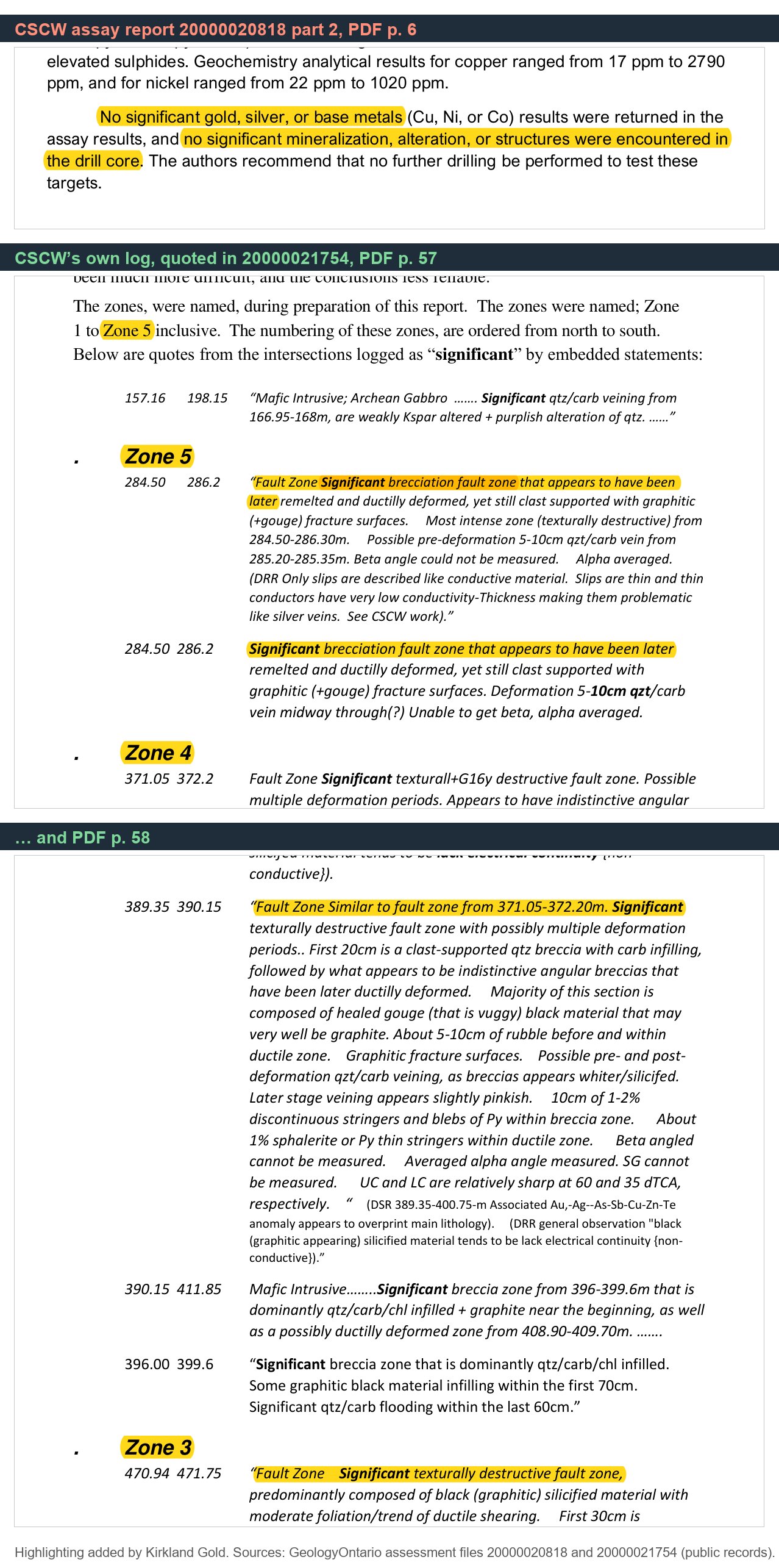
No significant mineralization, alteration, or structures were encountered in the drill core.Summary, p. 6 of the PDF |
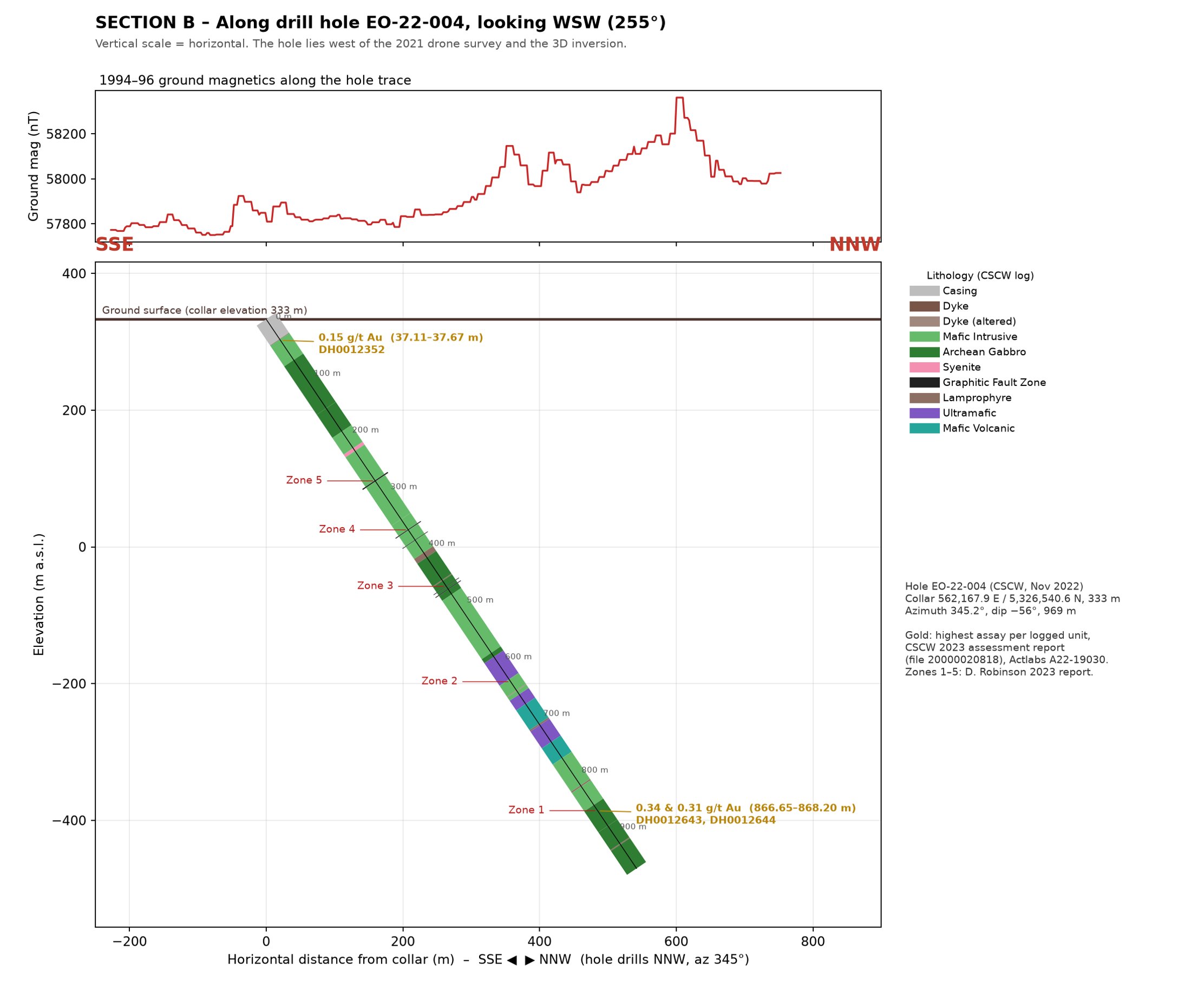
CSCW’s own core log calls these intervals significant: brecciated, texturally destructive fault zones at 284.5, 371.1, 389–412 and 471–477 m; a quartz–carbonate zone with 4–5% pyrite at 643.7 m; and a chlorite–silica–sericite–fuchsite altered, quartz-veined zone at 866–870.5 m. Doug Robinson numbered them Zones 1 to 5.See the proof Full report |
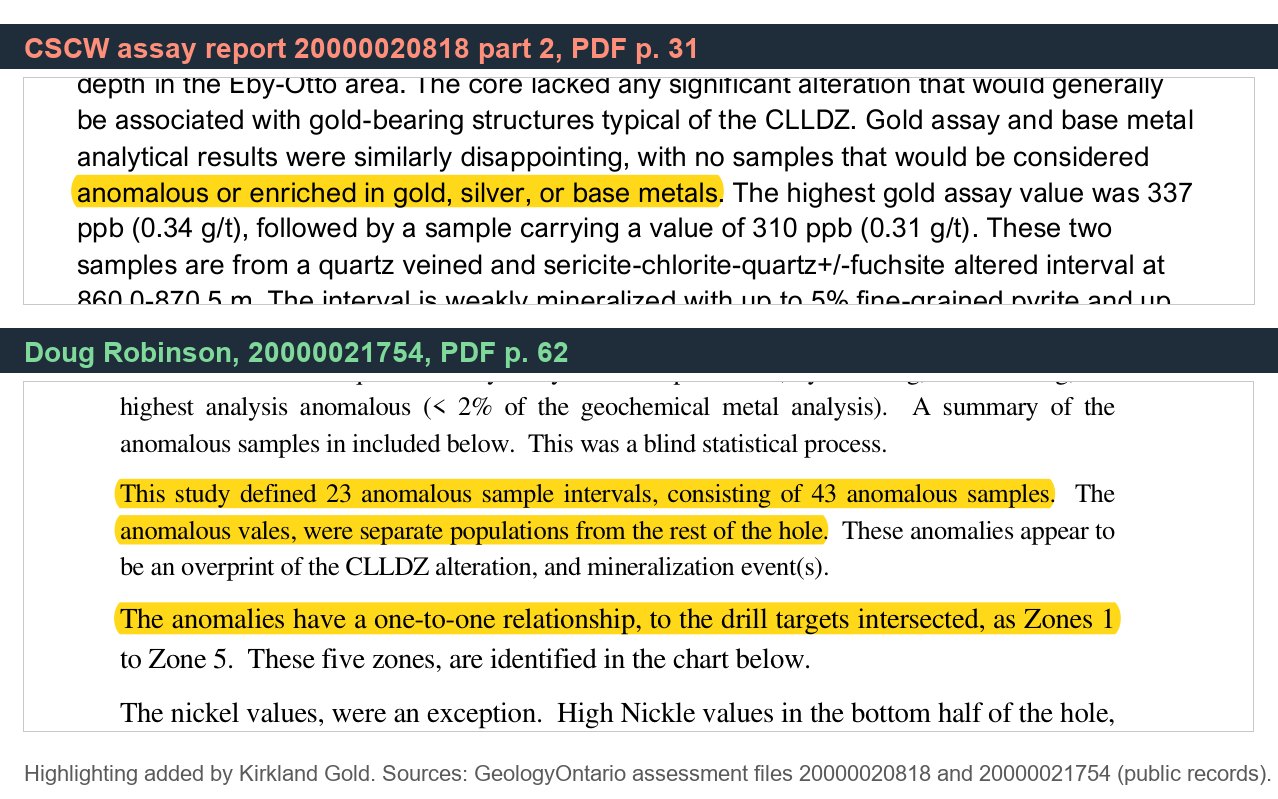
No samples that would be considered anomalous or enriched in gold, silver, or base metals.Recommendations, p. 31 of the PDF |
A blind statistical review of the same 326 Actlabs analyses (the top 2% of each element) found five anomalous zones, standing apart from the rest of the hole as separate populations – the same Zones 1 to 5 the core logger marked as important structures. Zone 1: 0.32 g Au/mT over 1.55 m. Zone 2: anomalous in Au, Ag, As, Sb, Te, Cu. Zone 3: Au, Ag, Te, Cu, Zn, Co. Zone 4: Au, Ag, As, Sb, Te, Cu, Zn. Zone 5: Ag, Zn.See the proof Full report |
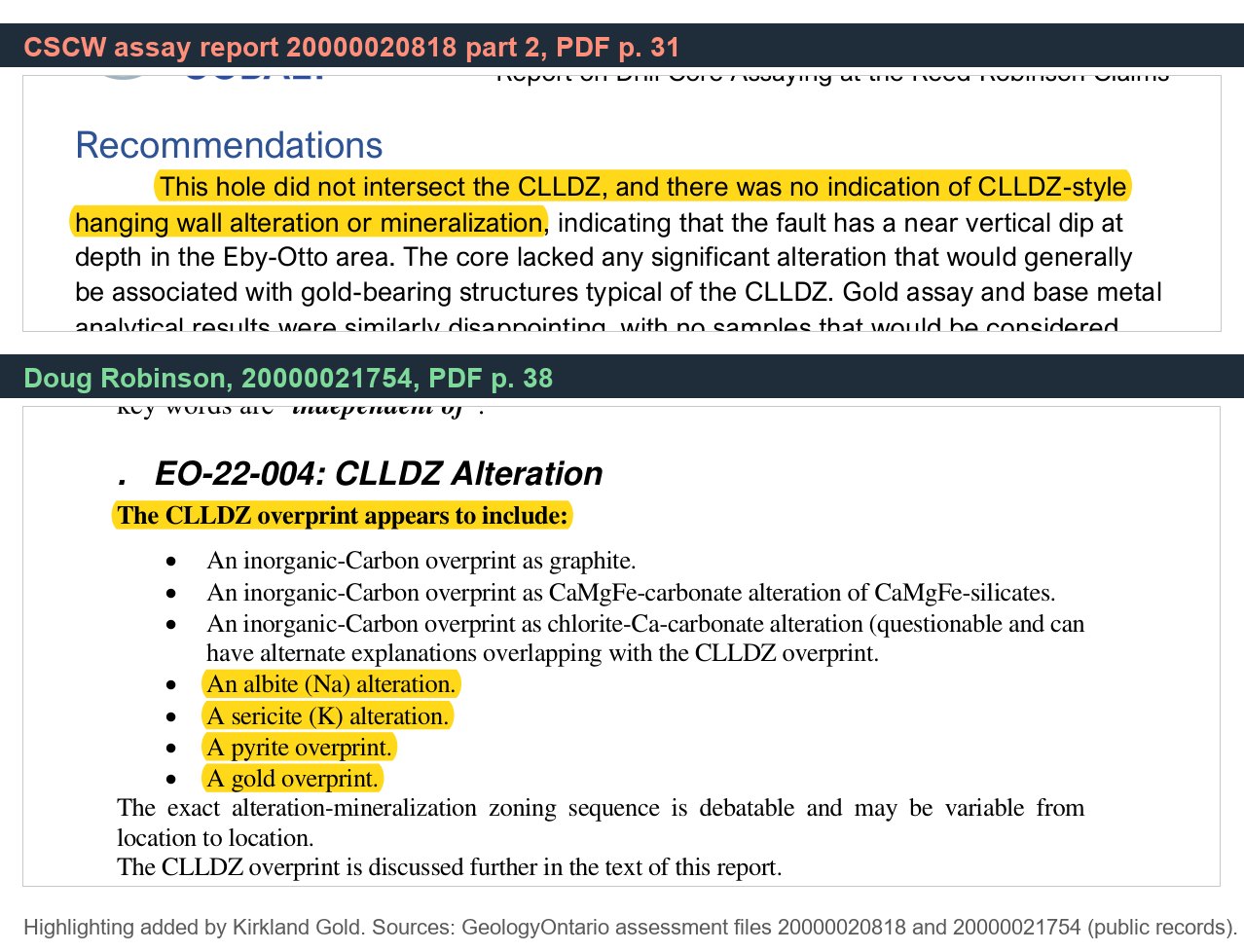
This hole did not intersect the CLLDZ, and there was no indication of CLLDZ-style hanging wall alteration.Recommendations, p. 31 |
The anomalous zones carry the signs of the Cadillac–Larder Lake deformation zone’s alteration: graphite, iron–carbonate, albite (sodium), sericite (potassium), pyrite and gold. The re-log confirmed intense albite alteration at 587.5–588.7 m by XRF (logged by CSCW as silicification), and XRF at 372.0 m shows 5.7% potassium.See the proof Full report |
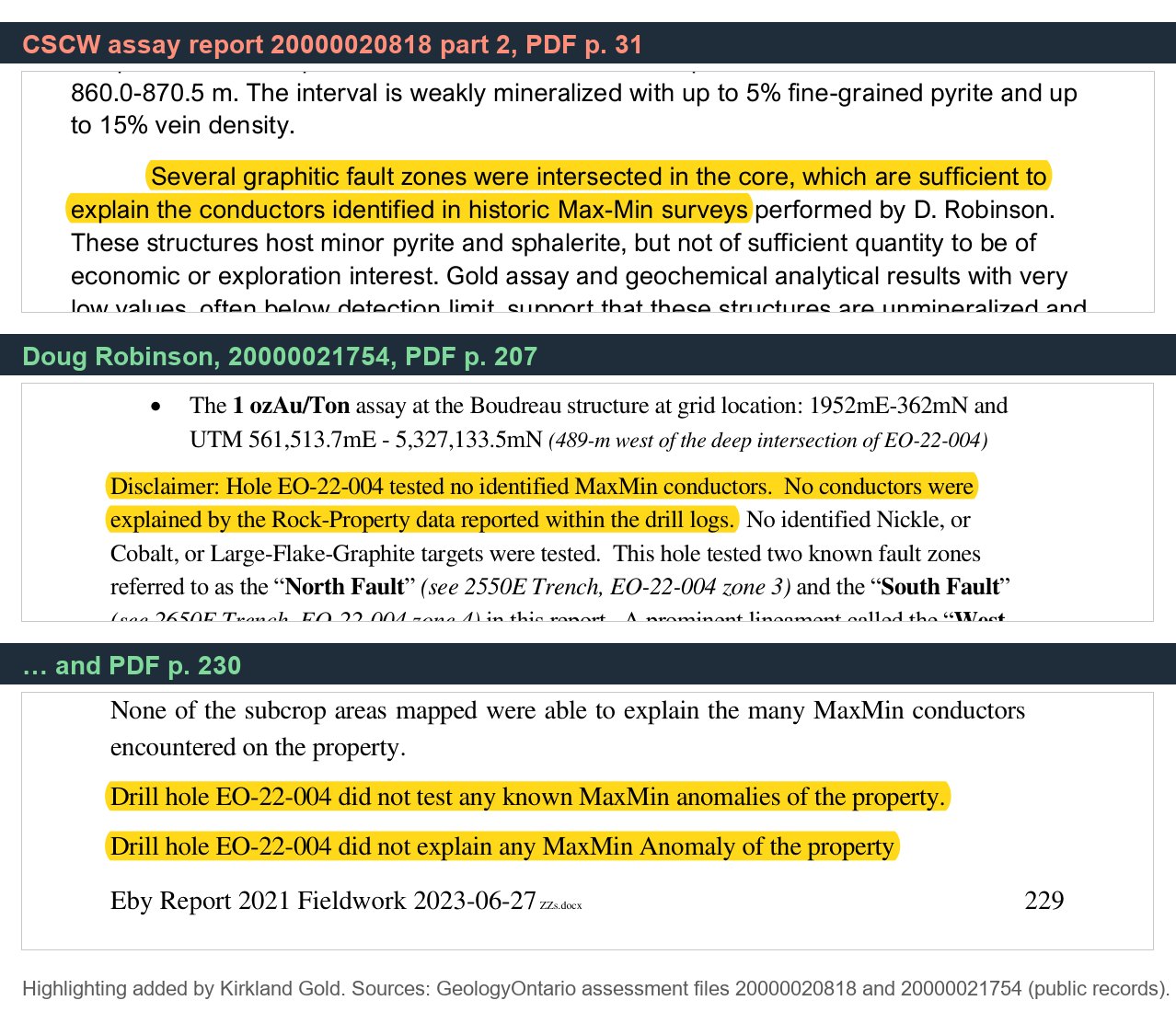
Several graphitic fault zones … are sufficient to explain the conductors identified in historic Max-Min surveys.Recommendations, p. 31 |
The hole tested no identified MaxMin conductor. When the black zones were measured in the re-log, conductivity was 0.0 S/m at every point in 284.5–286.3 m and 389.4–390.8 m, and generally 0.0 in 470.9–476.8 m. Only thin pyrite bands carry current, over centimetres. The black zones are mostly bedded tuff, argillite and chert, not graphitic faults. A non-conductor cannot explain a conductor.See the proof Full report |
The authors recommend that no additional work be performed to explore for gold, silver, base, or critical metals on these claims.Recommendations, p. 31 |
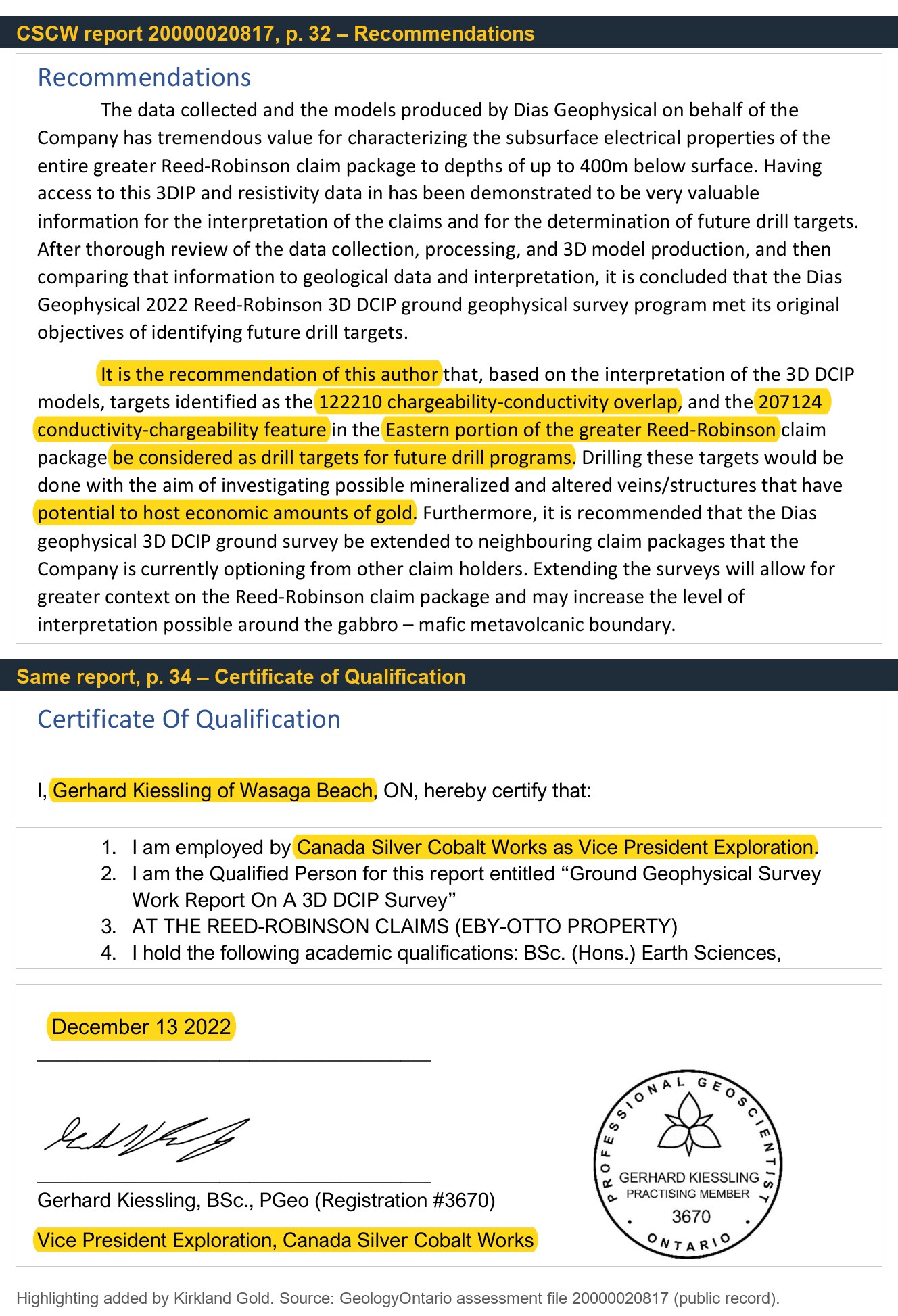
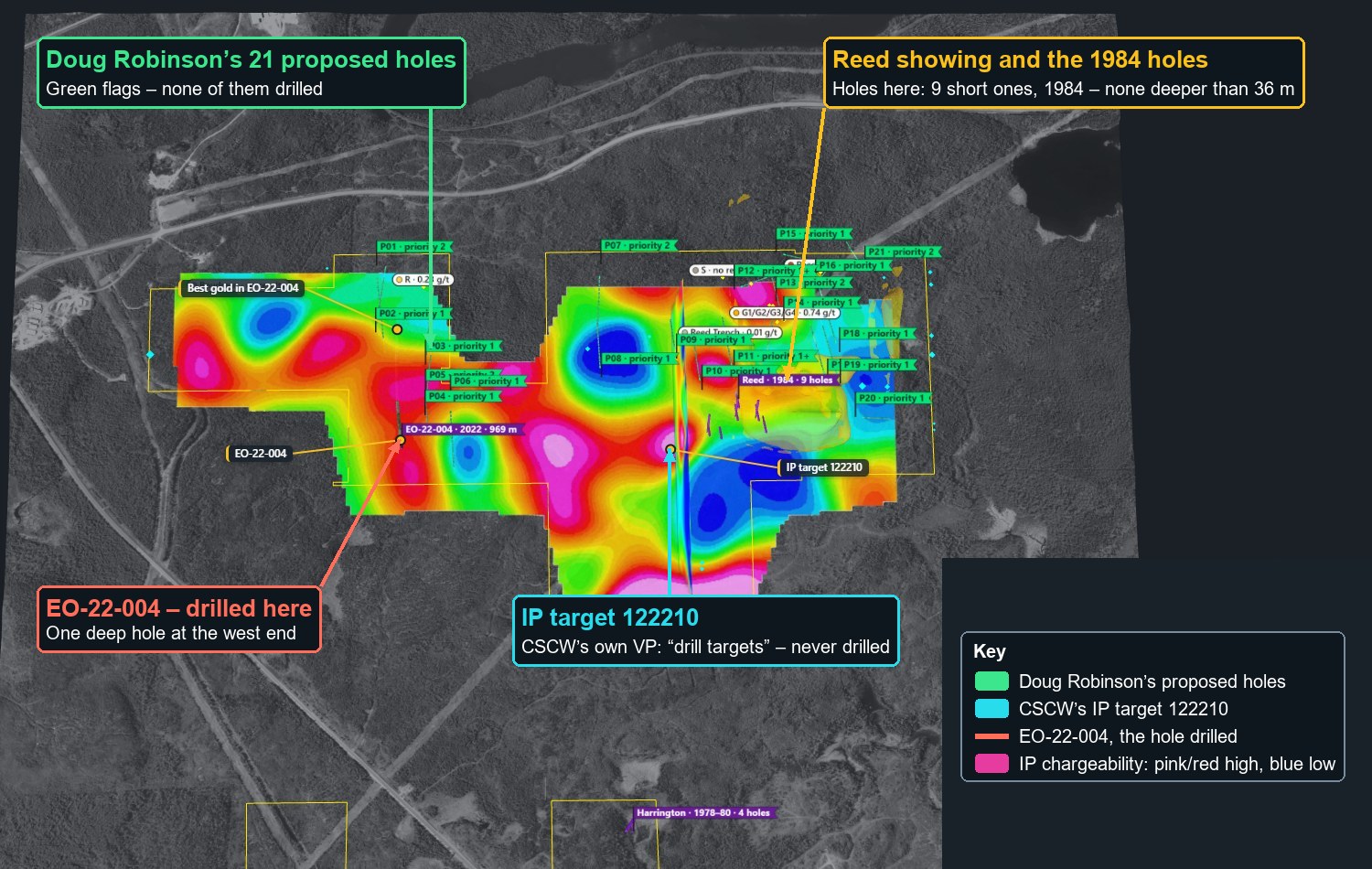
CSCW’s own 3D IP report on the same claims, filed the same year, says the opposite: targets “in the Eastern portion of the greater Reed-Robinson claim package be considered as drill targets for future drill programs”, with the aim of finding veins that “have potential to host economic amounts of gold”. It was signed by CSCW’s own Vice President Exploration. Neither target was drilled.See the proof Full report |
| The hole as logged: mostly mafic intrusive rock and gabbro.20000020818 part 1 | Re-logged, about 570 m of the hole between 157 and 774 m is volcanic: mafic flows and flow breccias, amphibole porphyry flows and ultramafic flows, with bedded sediments between them. A layered volcanic sequence cut by faults and veins – not one uniform intrusion.See the proof Full report |
CSCW’s own reports, side by side
Everything CSCW filed on this ground, with what each one says. Open any of them – the PDFs are public on GeologyOntario.
- 20000020517 – Aerial drone magnetic survey and 3D inversion (EarthEx, 2022). 684 line-km over the whole option. The contractor notes the property covers the Eby–Otto fault zone “just south of the prolific Cadillac Break”, says the data show far more structure than existing maps, and recommends a full litho-structural interpretation. Our record page
- 20000020817 – 3D DC resistivity and IP survey (Dias Geophysical, 2022). Recommends drilling the 122210 and 207124 chargeability–conductivity targets in the eastern claims, shallower than 400 m (p. 33; see it highlighted, with the signature). Not drilled. Our record page
- 20000020818, part 1 – Diamond drilling report, hole EO-22-004 (2022). The core log, with the embedded “significant” zone notes. Our record page
- 20000020818, part 2 – Drill core assay and geochemical results (2023). The report that recommends no further work (p. 31), written after one hole, while the IP report’s targets and the rest of the four-hole program sat undrilled.
- 20000021754 – Doug Robinson, P.Eng.: deposit and alteration model, 2021 field work and EO-22-004 (2023). 327 pages. The review this page draws on, and his proposed drill holes (p. 244). Our record page
Where they drilled, and where they didn’t
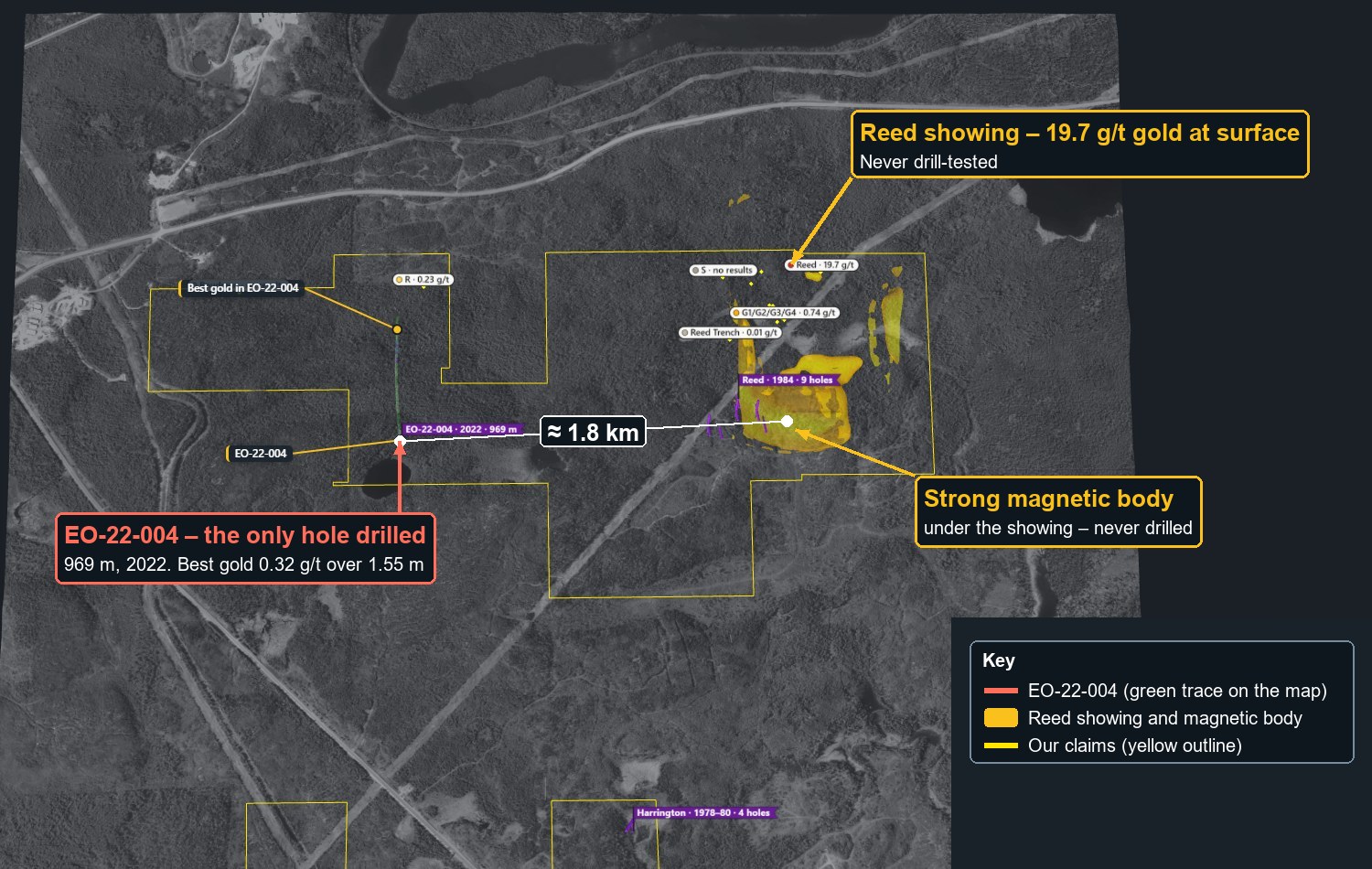
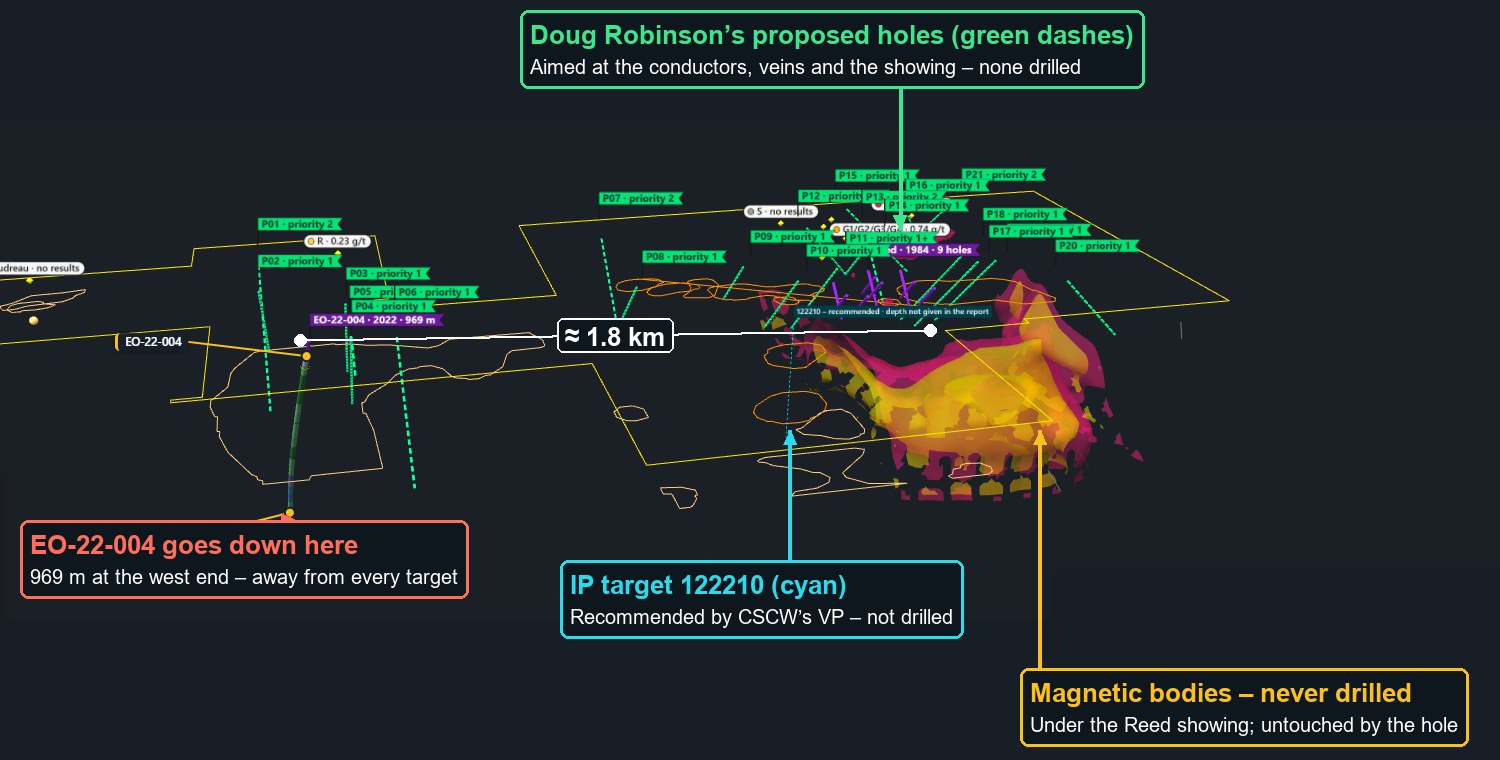
Three views from our Property Viewer, as any visitor sees them – two looking straight down, one below ground. Click any one to open it live in 3D (in a new tab) and turn it yourself.
Would our model have picked this hole – this spot, this angle, this depth?
We put a theoretical hole at EO-22-004’s exact collar, direction, dip and length, and scored it with the Property Viewer’s own target rules – surface signs only (gold in surface samples, magnetic lows, IP chargeability, conductors, alteration, structure), weighted from Doug Robinson’s reports. Nothing found in the real hole goes in.
No. It scores 21 out of 100 – below every one of the 52 targets on our map (they score 30 to 71).
- Its best point (21) is about 214 m down the hole, 57 m to one side of it. Along the rest of its 969 m it passes only two weaker spots (19 each) – all below the 30 points our map needs to call something a target.
- For value for money it comes 21st of 21 among the proposed holes – last.
- For its $218,025, the 4 best-value proposed holes (P13, P05, P16, P14) could all be drilled – 758 m for $170,550, scoring 71, 32, 47, 49.
What the AI said
We asked an AI assistant to make this check without being shown the hole’s results: place a straight hole at EO-22-004’s collar, angle and length, and score it with the same rules used for every target and every proposed hole. Its answer: it would not have chosen this hole. The hole passes some surface signs on its way down – an EM conductor, a ground magnetic low, iron-carbonate alteration, high IP chargeability and a mapped swamp – but nowhere along its 969 m does it pass anything as strong as the 52 targets it would have drilled first.
Where its best point lies and the two weaker spots come from the Property Viewer’s blind check (re-run 2026-11-01). The weights are our reading of Doug Robinson’s reports, with the surveys ranked by the owners (EM first, then the ground and drone magnetics, IP and the soil); the score moves if they change.
Every proposed hole, scored the same way
Doug Robinson’s 20 proposed holes that test a target, from his filed report, and EO-22-004 placed blind among them. Each hole gets the score of the best target it passes within 75 m of. Sorted by value for money – how much score each dollar of drilling buys; click any heading to sort another way. EO-22-004 comes last of 21. Its score ties with 2 others on 21, but at 969 m it costs the most of any hole here.
Sort by:
| Rank | Hole | Ratingtotal /100 = score + value for money | Length (m) | Est. cost | Signs at its best target |
|---|---|---|---|---|---|
| 1 | P13 Doug Robinson, 2022 | 86 | 200 | $45,000 | EM (MaxMin) conductor, Pyrite (–albite) alteration, Gold in surface samples, Fault or structure striking 070–090° (Larder Lake breaks), Iron-carbonate alteration, Fault or structure (135° Lincoln Continental trend), Magnetic low, broad area (ground, 1994–96), Magnetic low (drone, 2021), Quartz vein or breccia, High IP chargeability, Inside a mapped swamp, Sericite / potassic alteration |
| 2 | P05 Doug Robinson, 2022 | 61 | 100 | $22,500 | Gold in surface samples, Iron-carbonate alteration, Magnetic low, broad area (ground, 1994–96), High IP chargeability, Edge of a magnetic high and low, Wet-ground note (swamp lineament), Inside a mapped swamp |
| 3 | P16 Doug Robinson, 2022 | 55 | 208 | $46,800 | Pyrite (–albite) alteration, Gold in surface samples, Fault or structure striking 070–090° (Larder Lake breaks), Magnetic low, broad area (ground, 1994–96), Quartz vein or breccia, Magnetic body (drone model), Edge of a magnetic high and low, Inside a mapped swamp |
| 4 | P14 Doug Robinson, 2022 | 52 | 250 | $56,250 | Pyrite (–albite) alteration, Gold in surface samples, Iron-carbonate alteration, Fault or structure (135° Lincoln Continental trend), Magnetic low, broad area (ground, 1994–96), Magnetic low (drone, 2021), Quartz vein or breccia, High IP chargeability, Inside a mapped swamp |
| 5 | P20 Doug Robinson, 2022 | 42 | 225 | $50,625 | Pyrite (–albite) alteration, Gold in surface samples, Iron-carbonate alteration, High IP chargeability, Edge of a magnetic high and low, Wet-ground note (swamp lineament), Inside a mapped swamp |
| 6 | P11 Doug Robinson, 2022 | 40 | 400 | $90,000 | EM (MaxMin) conductor, Pyrite (–albite) alteration, Fault or structure striking 070–090° (Larder Lake breaks), Iron-carbonate alteration, Quartz vein or breccia, Low resistivity (high conductivity) in IP, Inside a mapped swamp |
| 7 | P01 Doug Robinson, 2022 | 36 | 400 | $90,000 | Pyrite (–albite) alteration, Gold in surface samples, Iron-carbonate alteration, Magnetic low, broad area (ground, 1994–96), Quartz vein or breccia, Low resistivity (high conductivity) in IP, Edge of a magnetic high and low, Inside a mapped swamp |
| 8 | P09 Doug Robinson, 2022 | 22 | 200 | $45,000 | EM (MaxMin) conductor, Magnetic low, broad area (ground, 1994–96), Inside a mapped swamp |
| 9 | P03 Doug Robinson, 2022 | 33 | 450 | $101,250 | EM (MaxMin) conductor, Gold in surface samples, Magnetic low, broad area (ground, 1994–96), High IP chargeability, Low resistivity (high conductivity) in IP, Edge of a magnetic high and low, Inside a mapped swamp |
| 10 | P12 Doug Robinson, 2022 | 22 | 250 | $56,250 | Fault or structure (135° Lincoln Continental trend), Magnetic low, broad area (ground, 1994–96), Magnetic low (drone, 2021), Quartz vein or breccia, High IP chargeability, Inside a mapped swamp |
| 11 | P04 Doug Robinson, 2022 | 26 | 450 | $101,250 | Gold in surface samples, Iron-carbonate alteration, Magnetic low, broad area (ground, 1994–96), High IP chargeability, Edge of a magnetic high and low, Wet-ground note (swamp lineament), Inside a mapped swamp |
| 12 | P02 Doug Robinson, 2022 | 24 | 400 | $90,000 | Gold in surface samples, Iron-carbonate alteration, High IP chargeability, Low resistivity (high conductivity) in IP, Edge of a magnetic high and low, Inside a mapped swamp |
| 13 | P08 Doug Robinson, 2022 | 18 | 300 | $67,500 | EM (MaxMin) conductor, High IP chargeability, Edge of a magnetic high and low, Inside a mapped swamp |
| 14= | P06 Doug Robinson, 2022 | 19 | 350 | $78,750 | Iron-carbonate alteration, Magnetic low, broad area (ground, 1994–96), High IP chargeability, Low resistivity (high conductivity) in IP, Edge of a magnetic high and low, Inside a mapped swamp |
| 15= | P19 Doug Robinson, 2022 | 20 | 400 | $90,000 | EM (MaxMin) conductor, Magnetic low, broad area (ground, 1994–96), Magnetic low (drone, 2021), High IP chargeability, Inside a mapped swamp |
| 15= | P10 Doug Robinson, 2022 | 17 | 300 | $67,500 | EM (MaxMin) conductor, Inside a mapped swamp |
| 17 | P17 Doug Robinson, 2022 | 20 | 425 | $95,625 | EM (MaxMin) conductor, Magnetic low, broad area (ground, 1994–96), Magnetic low (drone, 2021), High IP chargeability, Inside a mapped swamp |
| 18= | P07 Doug Robinson, 2022 | 15 | 300 | $67,500 | Iron-carbonate alteration, High IP chargeability, Edge of a magnetic high and low, Inside a mapped swamp |
| 18= | P15 Doug Robinson, 2022 | 15 | 300 | $67,500 | Gold in surface samples, Magnetic low, broad area (ground, 1994–96) |
| 20 | P18 Doug Robinson, 2022 | 17 | 510 | $114,750 | EM (MaxMin) conductor, Magnetic low, broad area (ground, 1994–96), Magnetic low (drone, 2021), High IP chargeability |
| 21 | EO-22-004 position theoretical hole – same spot, angle and depth, scored without its results | 14 | 969 | $218,025 | EM (MaxMin) conductor, Magnetic low, broad area (ground, 1994–96), High IP chargeability, Inside a mapped swamp |
Estimated cost = length × $225 per metre (the site’s current all-in drilling rate). Value for money = how many score points each $100,000 of drilling buys: the score divided by the cost, times $100,000. For example, P13 scores 71 for $45,000, so it buys about 158 points per $100k; EO-22-004 scores 21 but costs $218,025, so it buys about 10. Rating stacks the two, half each: the score (gold) and the value for money scaled so the best-value hole is 100 (blue); the big number is the total out of 100. The score ranks holes against each other from surface evidence; it is not a probability of finding gold. Scores from the Property Viewer’s target rules, 1 November 2026; weights still to be checked by Doug Robinson.
- EO-22-004 was a single deep test for the Cadillac–Larder Lake deformation zone, collared at grid 2608E / 259S on the west grid – the closest drillable spot to the break. Doug Robinson supported that one site (p. 207).
- It was meant to be the first of four. The other three – and the eastern targets: the Reed showing, the conductors beside it and the IP targets – were never drilled. Doug Robinson’s proposed holes are listed in his filed report (p. 244).
- So the program was stopped after its deepest, most distant hole, and the claims were written off on that one result.
The re-log: every metre, measured
In 2024 Doug Robinson, P.Eng., re-logged all 969 m of EO-22-004 at the core shed. He found every original sample mark again and drilled a permanent marker into the first piece of each sample, washed the core twice, and measured specific gravity (SG), magnetic susceptibility and – on every black unit – electrical conductivity, each reading checked against the rock it came from. His certified log is dated 15 October 2025.
The “graphitic faults”, measured
| Depth (m) | Logged by CSCW as | Re-logged as | Conductivity |
|---|---|---|---|
| 284.50–286.27 | Fault zone, graphitic fracture surfaces | Sheared volcanic flow breccia with black infill; chert band at 283.97 | 0.0 S/m at all 10 points tested |
| 371.06–372.89 | Fault zone in mafic intrusive | Bedded sediment: dolomite vein, black gouge with bedding, chert (SG 2.73), pyrite-banded sediment (SG 3.11) | 0.5–1.2 S/m in gouge; 0.0 in sediment |
| 389.35–390.81 | Fault zone in mafic intrusive | Chert, black fault chips, laminated tuff–argillite | 0.0 S/m at all 12 points tested |
| 470.94–471.73 | Fault zone, black graphitic silicified material | Classic bedded Archean tuff and argillite; 60% pyrite band at 471.35 | Generally 0.0; only the pyrite band is continuous |
| 474.75–476.75 | Fault zone in Archean gabbro | Interbedded tuff and black argillite, quartz masses | Generally 0.0 S/m |
For comparison, pyrrhotite fragments in the breccia at 232–253 m read up to 10.9 S/m – the meter works.
Rock properties by unit
Each rock type falls in a narrow SG range. That is how a log is checked – and why the sediments stand out.
| Unit (re-log) | Metres | SG readings | SG mean | Middle 80% | Mag. susc. middle 80% (10⁻³ SI) |
|---|---|---|---|---|---|
| Mafic volcanic flows | 322 | 178 | 2.88 | 2.80–2.96 | 0.9–6.8 |
| Mafic volcanic breccia | 51 | 25 | 2.87 | 2.81–2.93 | 0.8–3.7 |
| Mafic amphibole porphyry flows | 51 | 32 | 2.94 | 2.80–3.01 | 0.9–1.4 |
| Ultramafic flows | 148 | 80 | 2.84 | 2.80–2.88 | 1.2–55 |
| Mafic intrusive | 160 | 85 | 2.88 | 2.80–2.97 | 1.1–59 |
| Archean gabbro | 164 | 86 | 2.82 | 2.76–2.87 | 0.9–82 |
| Archean gabbro, strongly altered (gold zone) | 39 | 22 | 2.83 | 2.82–2.86 | 0.7–1.7 |
| Sediment: tuff, argillite, chert | 6 | 18 | 2.75 | 2.66–2.85 | 0.2–0.5 |
Calculated from Doug Robinson’s box log (21 July 2024, his final readings): 554 SG and 367 magnetic-susceptibility readings, grouped by the re-logged unit. Note the strongly altered gold-zone gabbro: its magnetite has been destroyed (susceptibility 0.7–1.7 against up to 82 in fresh gabbro) – a common sign of gold-related alteration.
The core itself
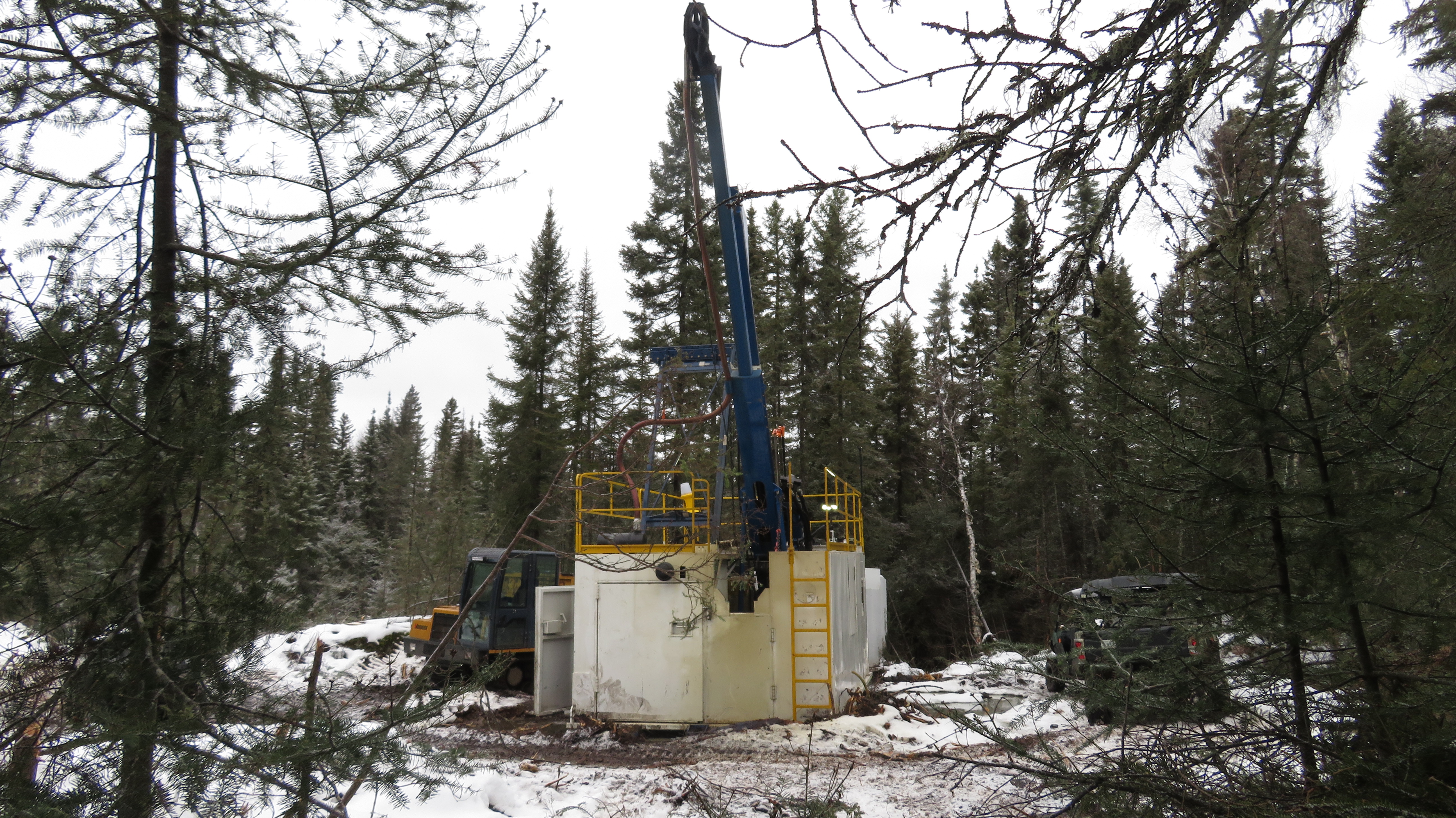
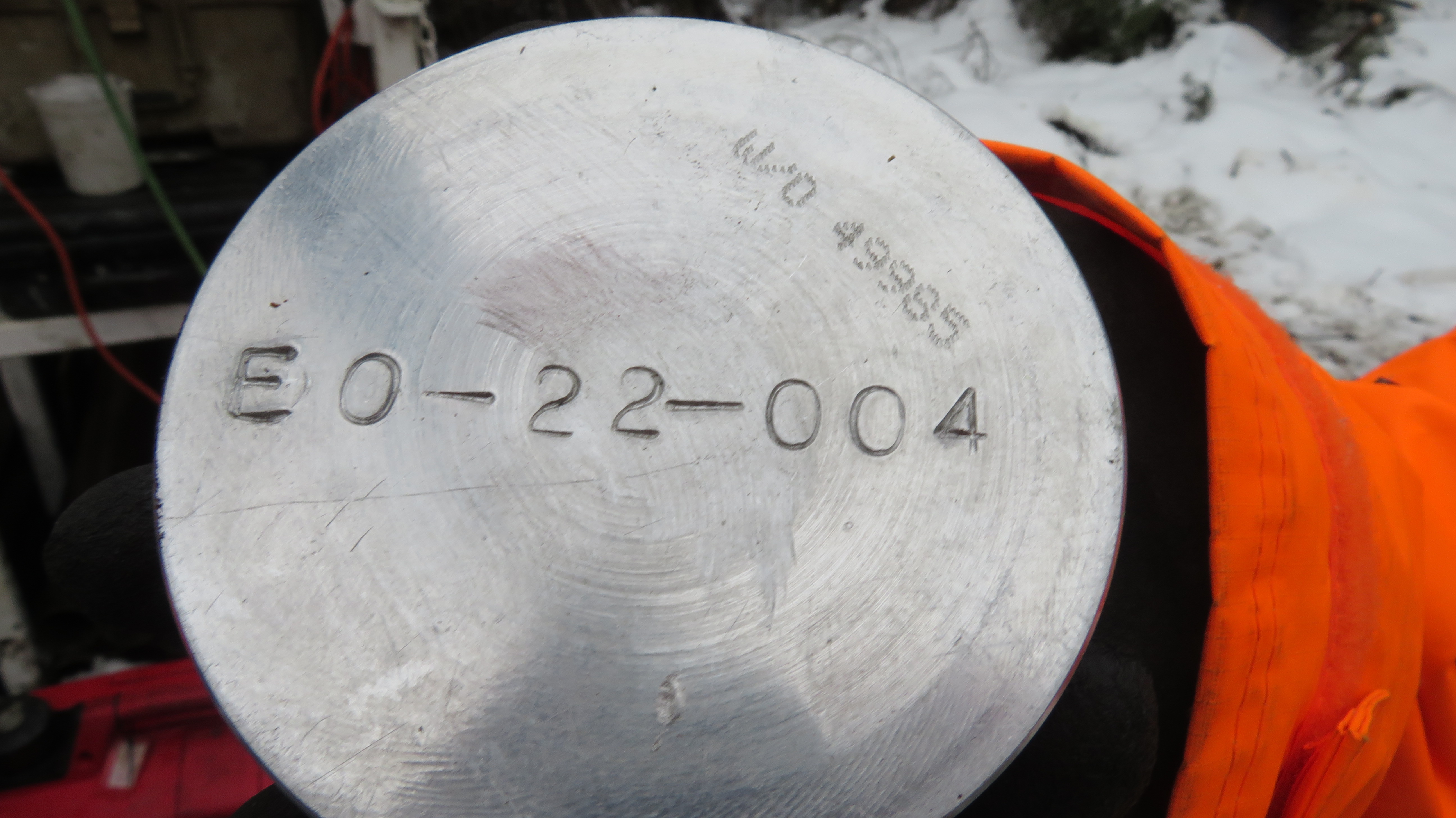
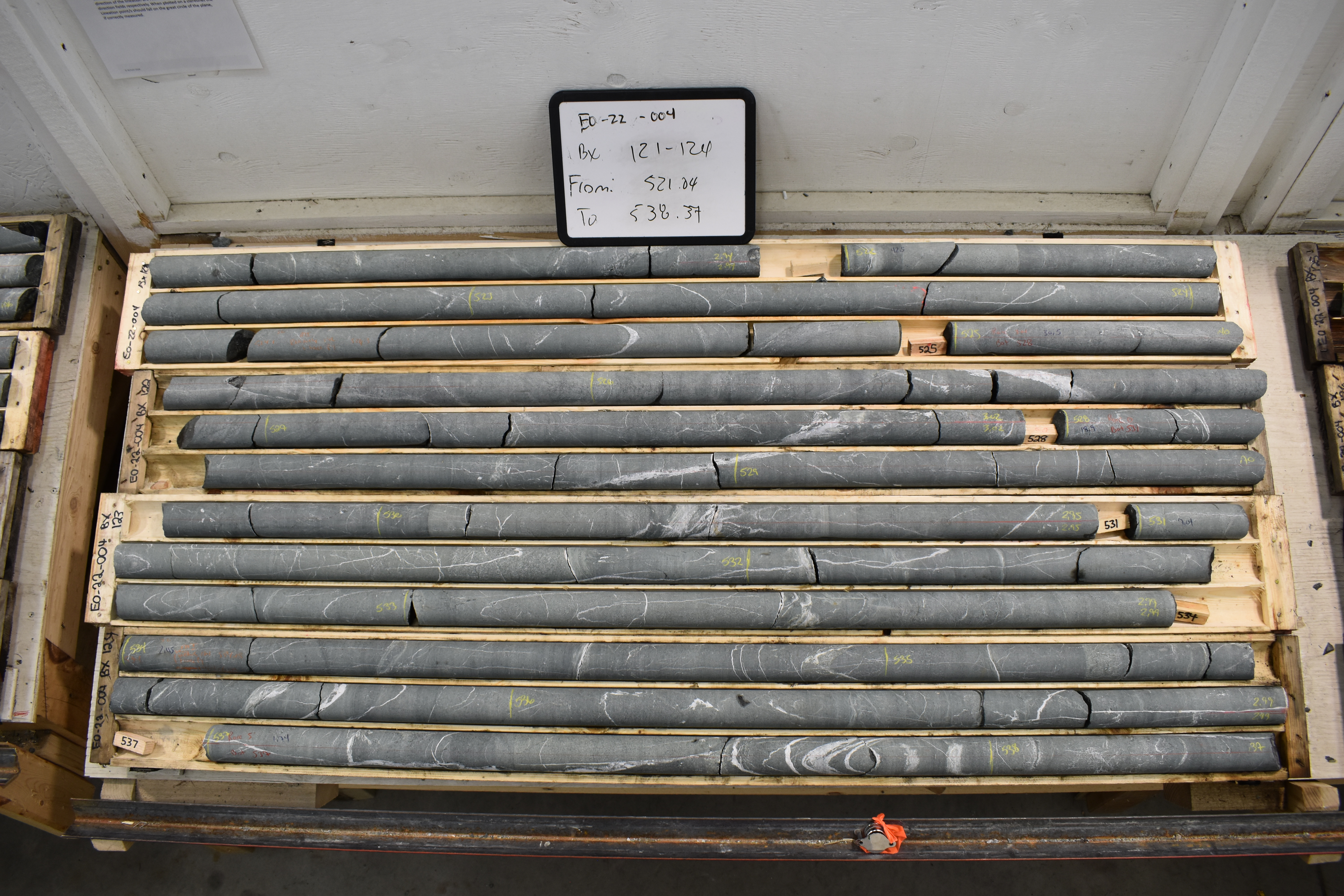
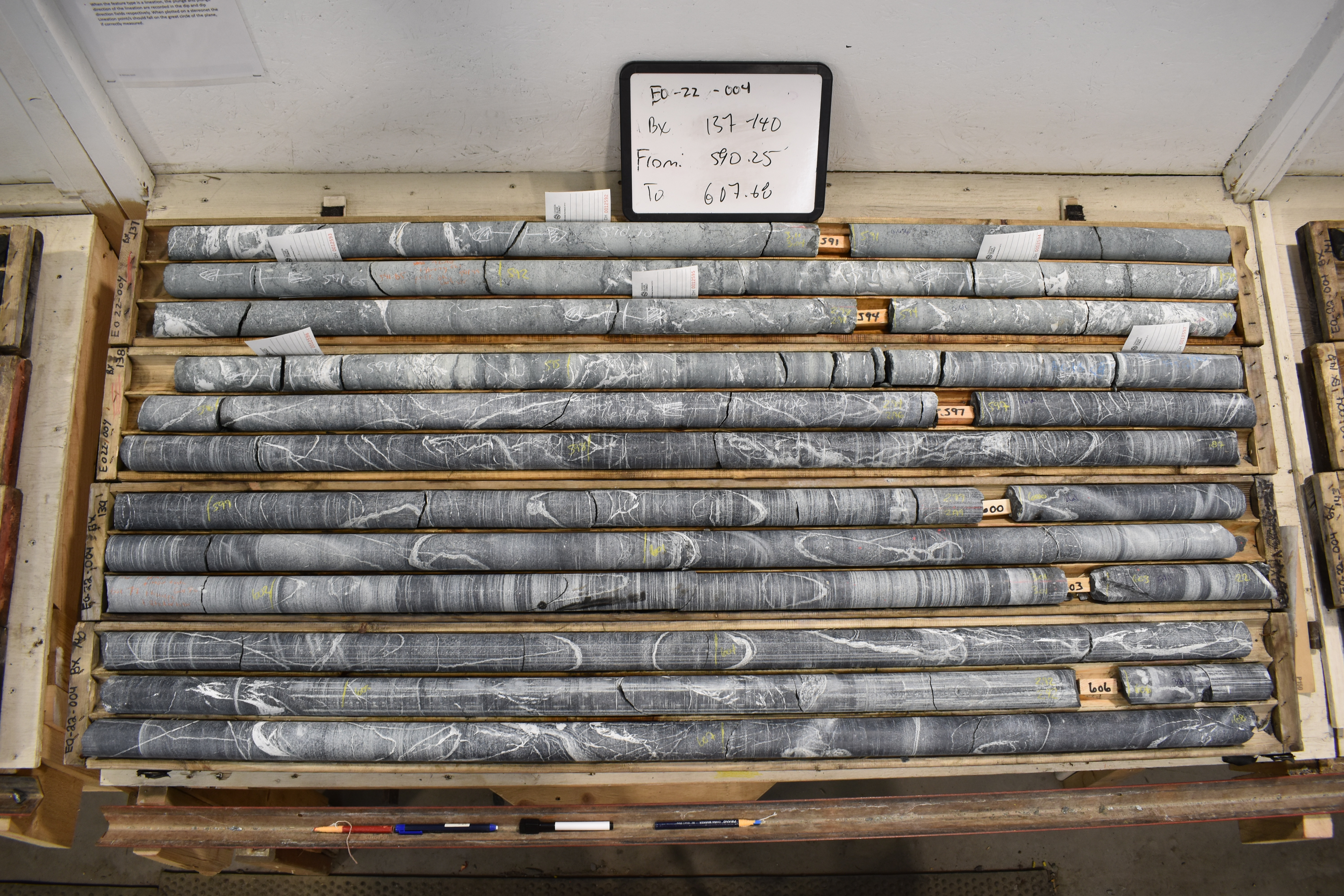
Photographed at the rig on 25 November 2022, as the hole passed the gold zone, and later in the core boxes. Click any picture to enlarge it.
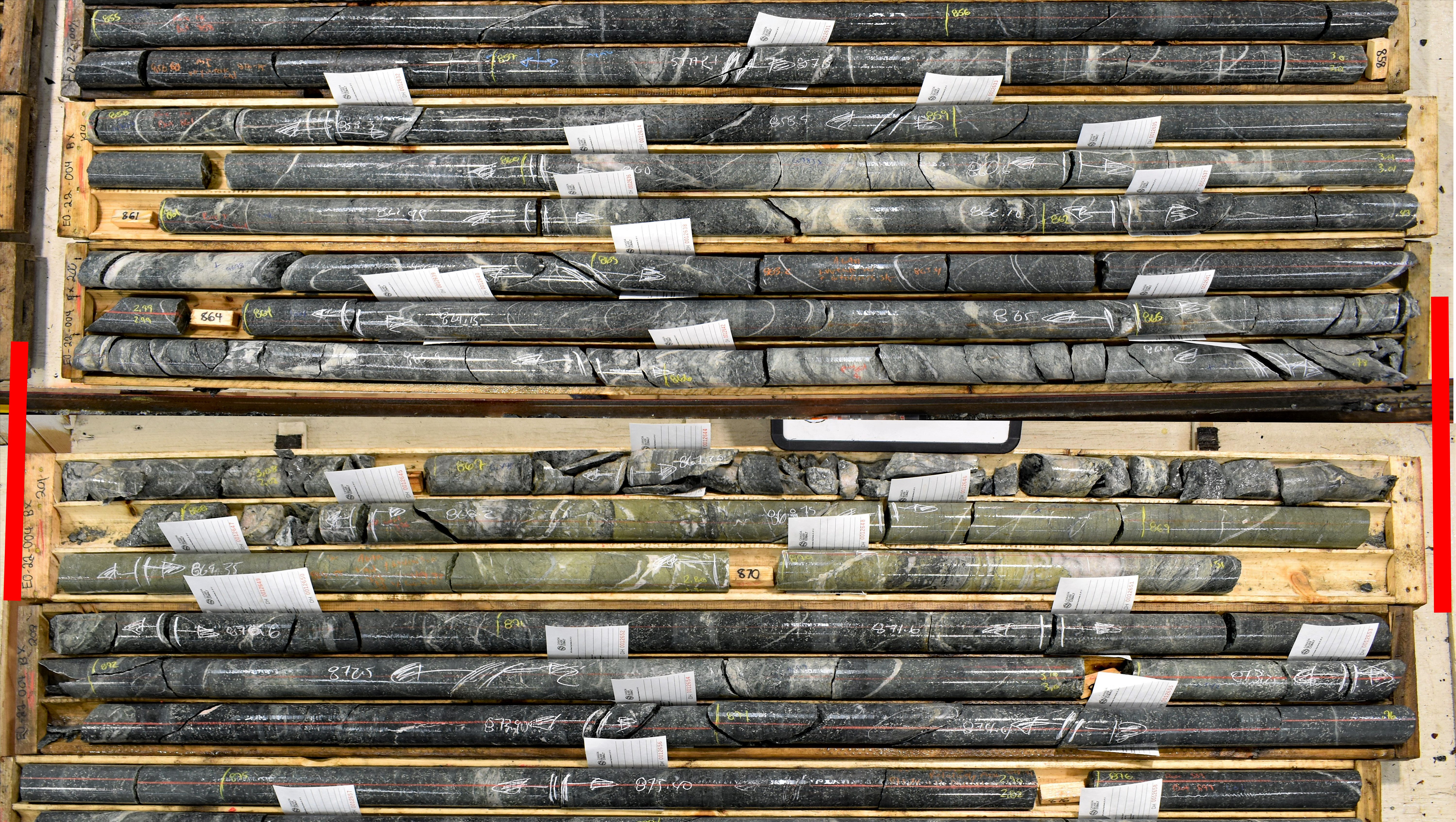
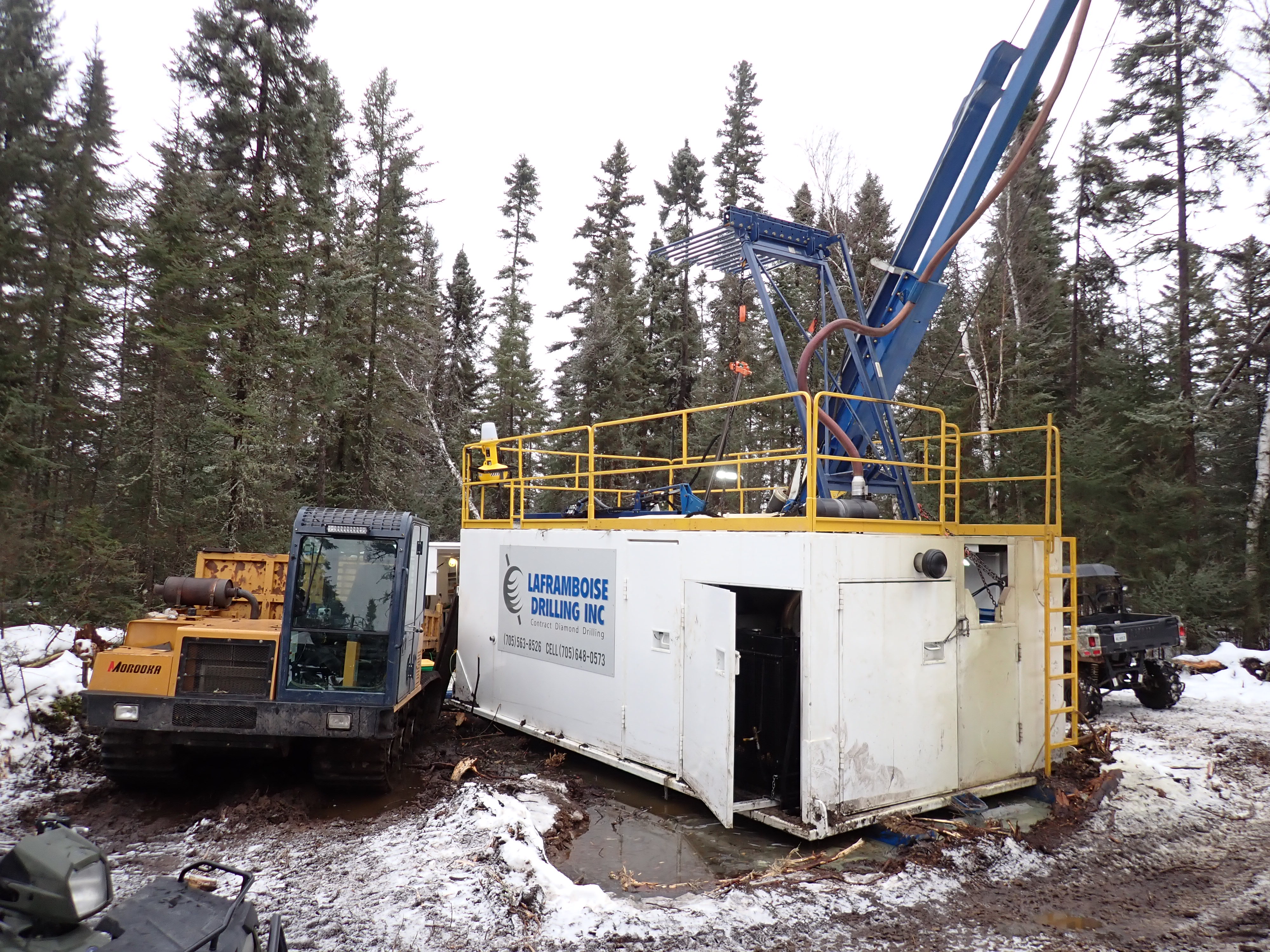
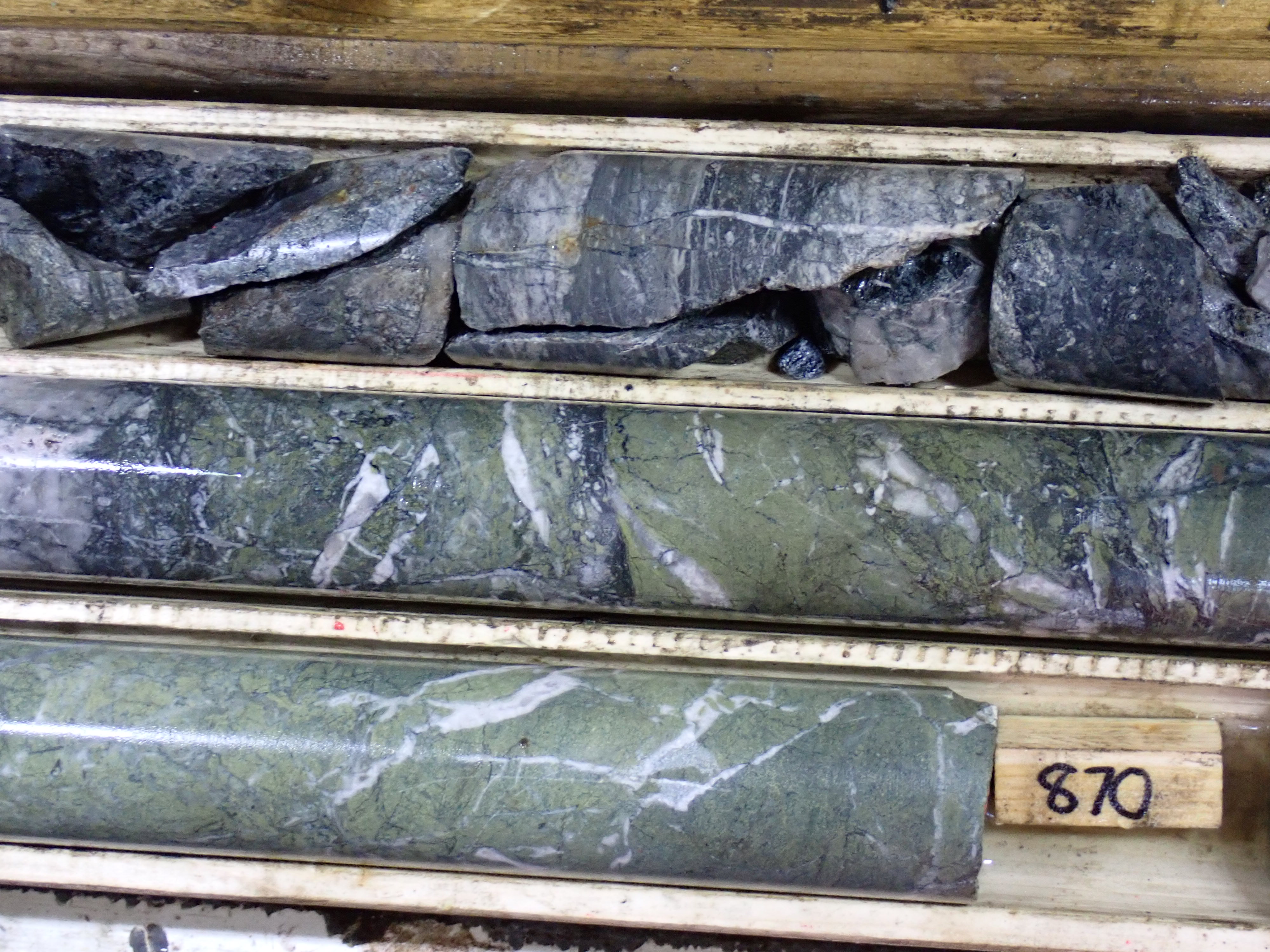
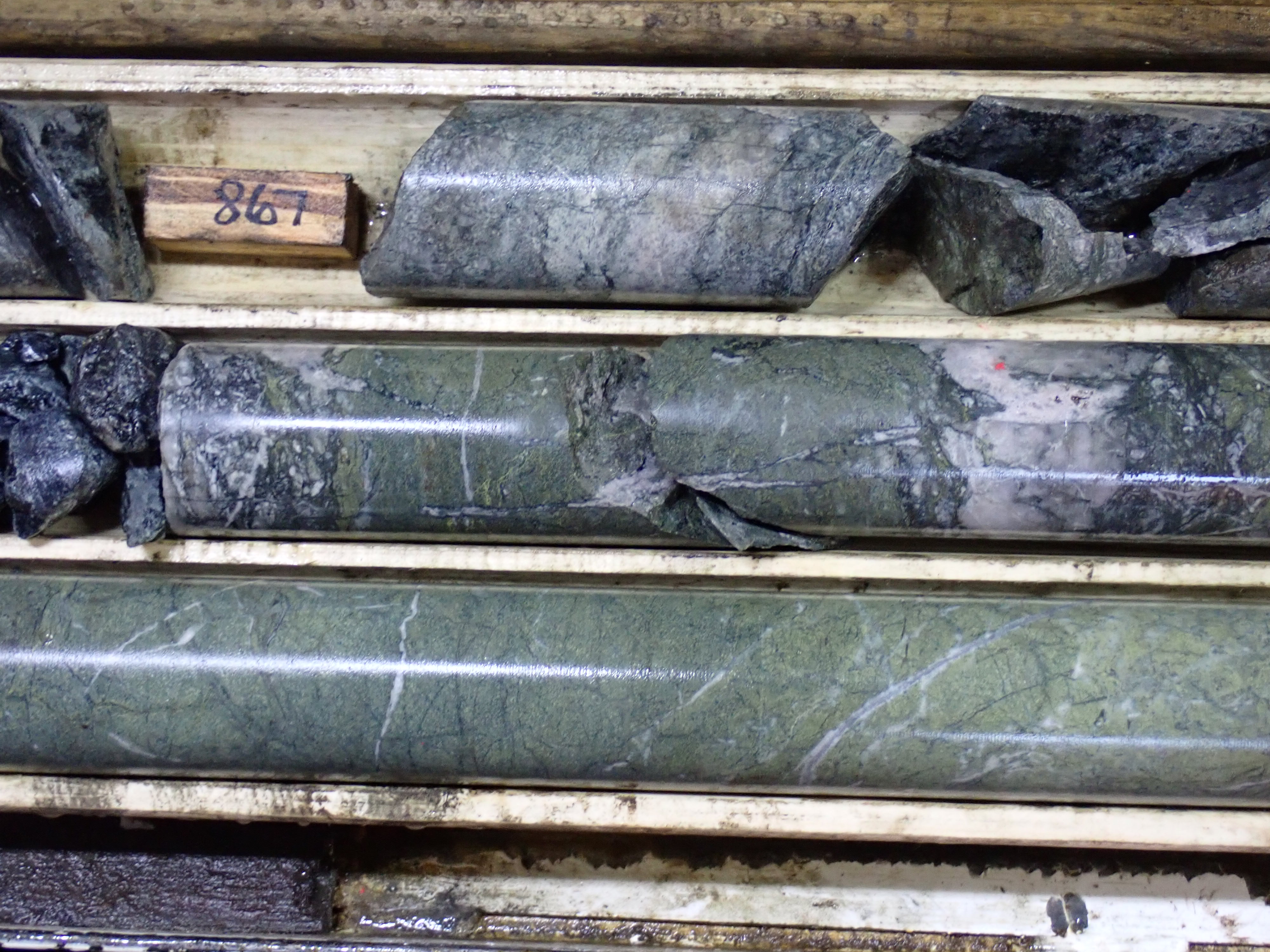
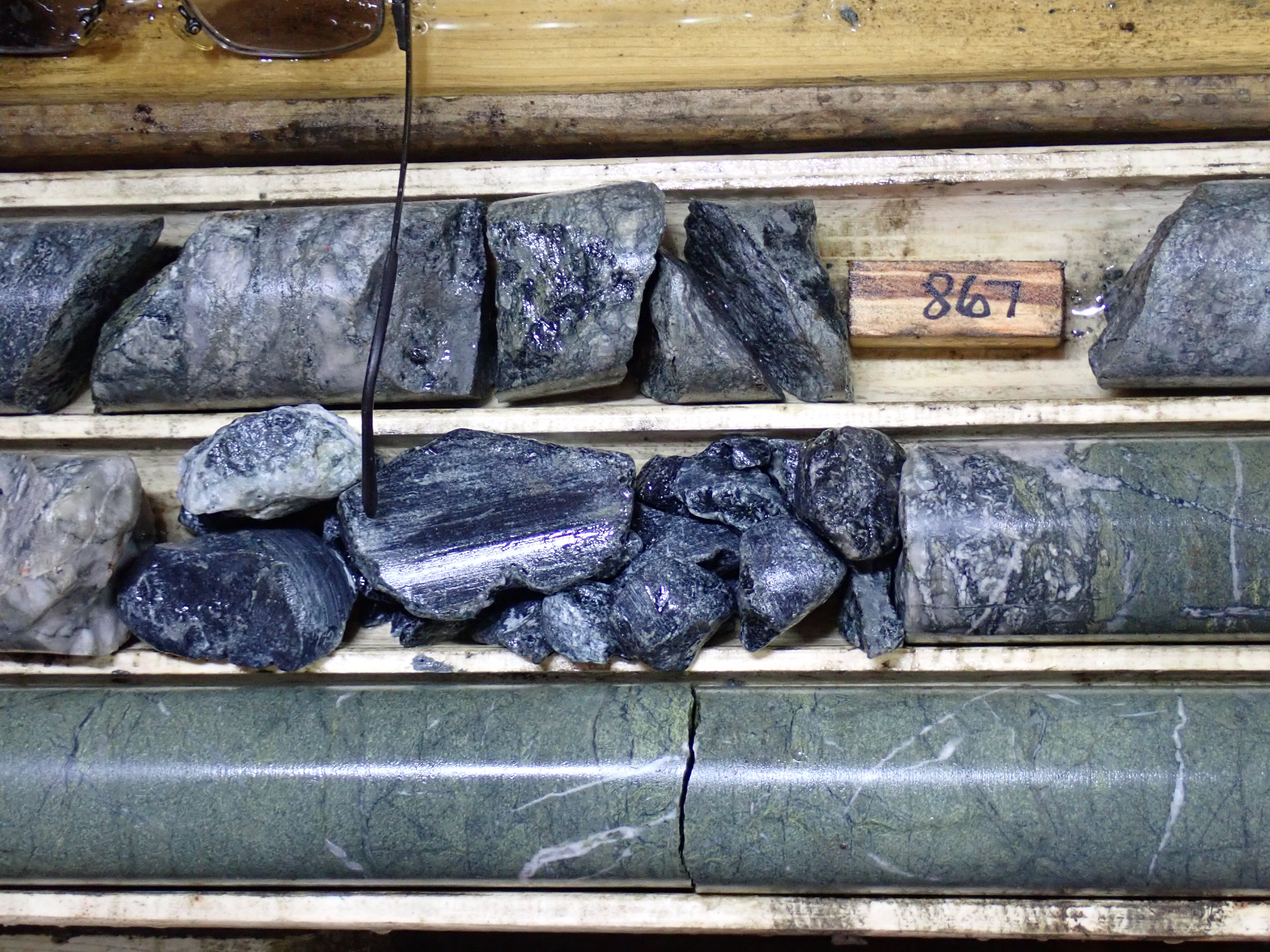
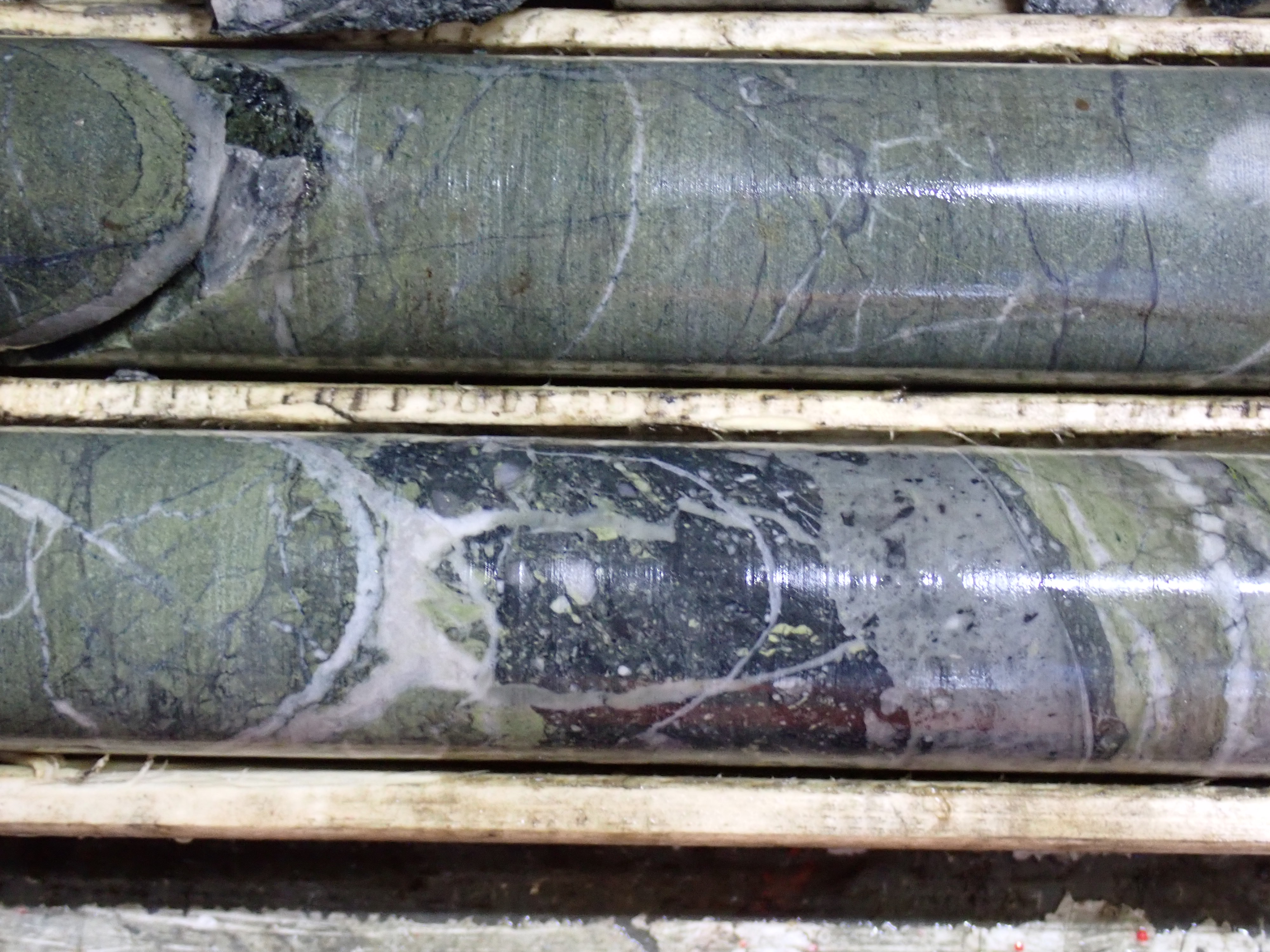
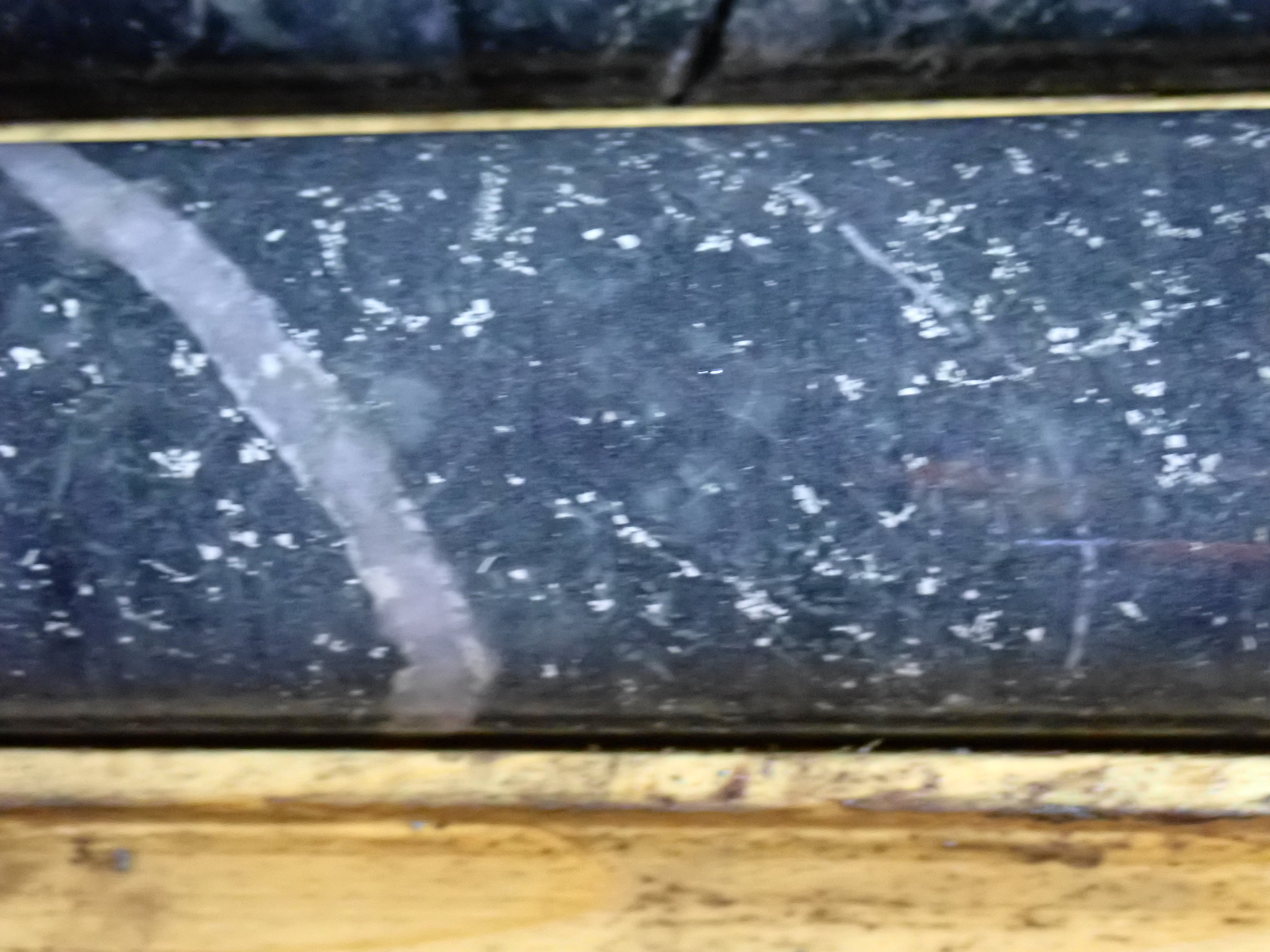
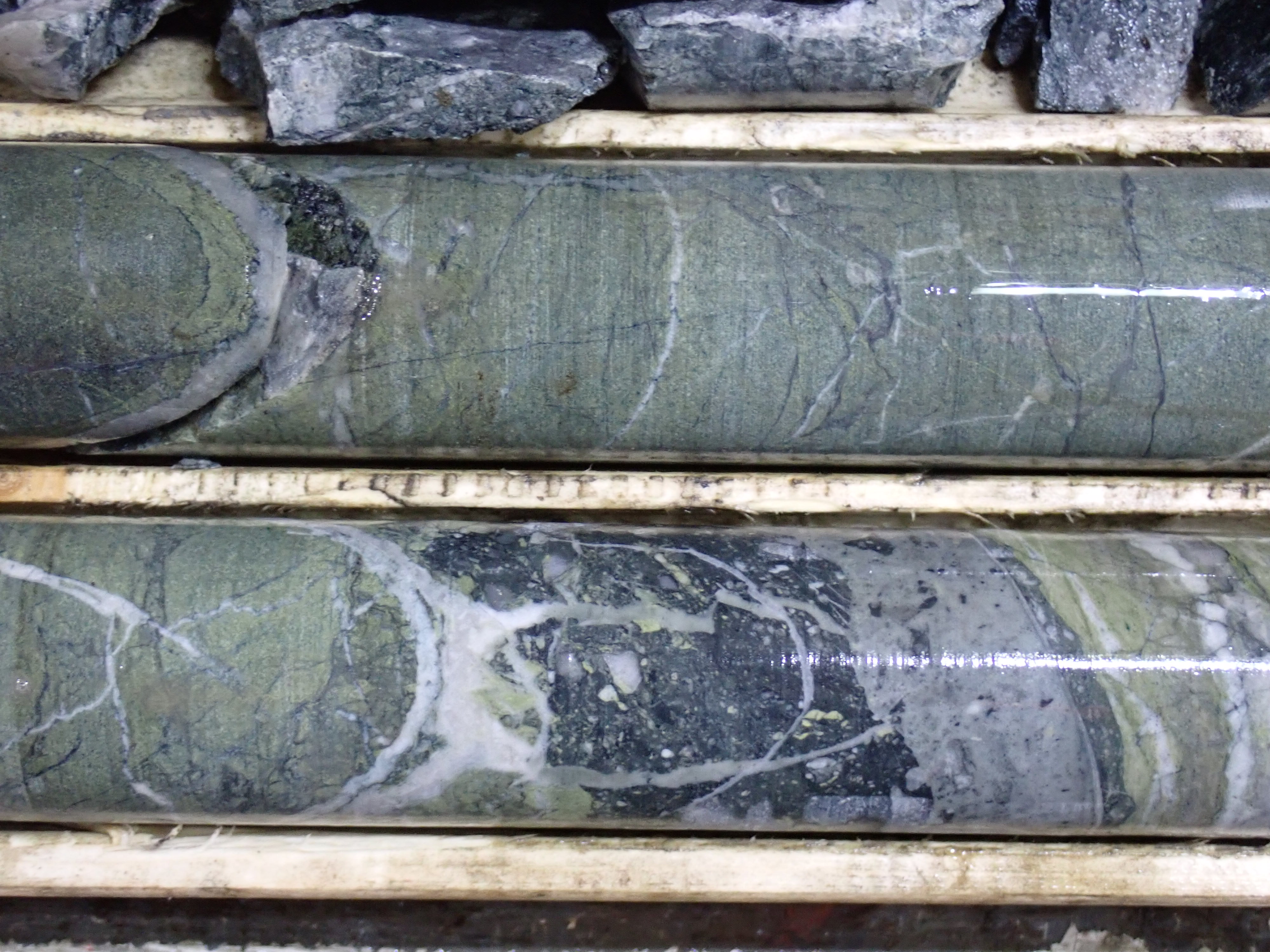
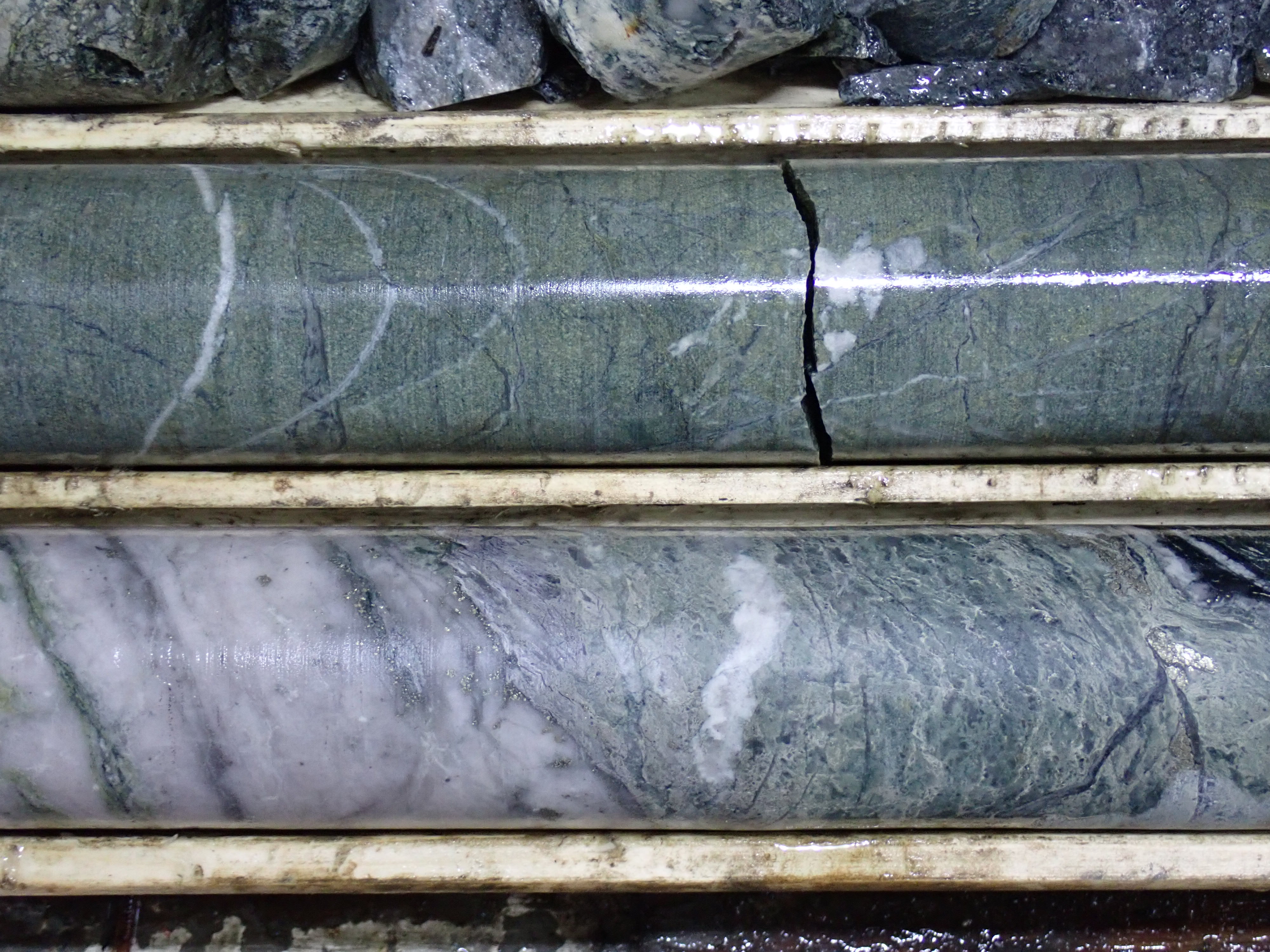
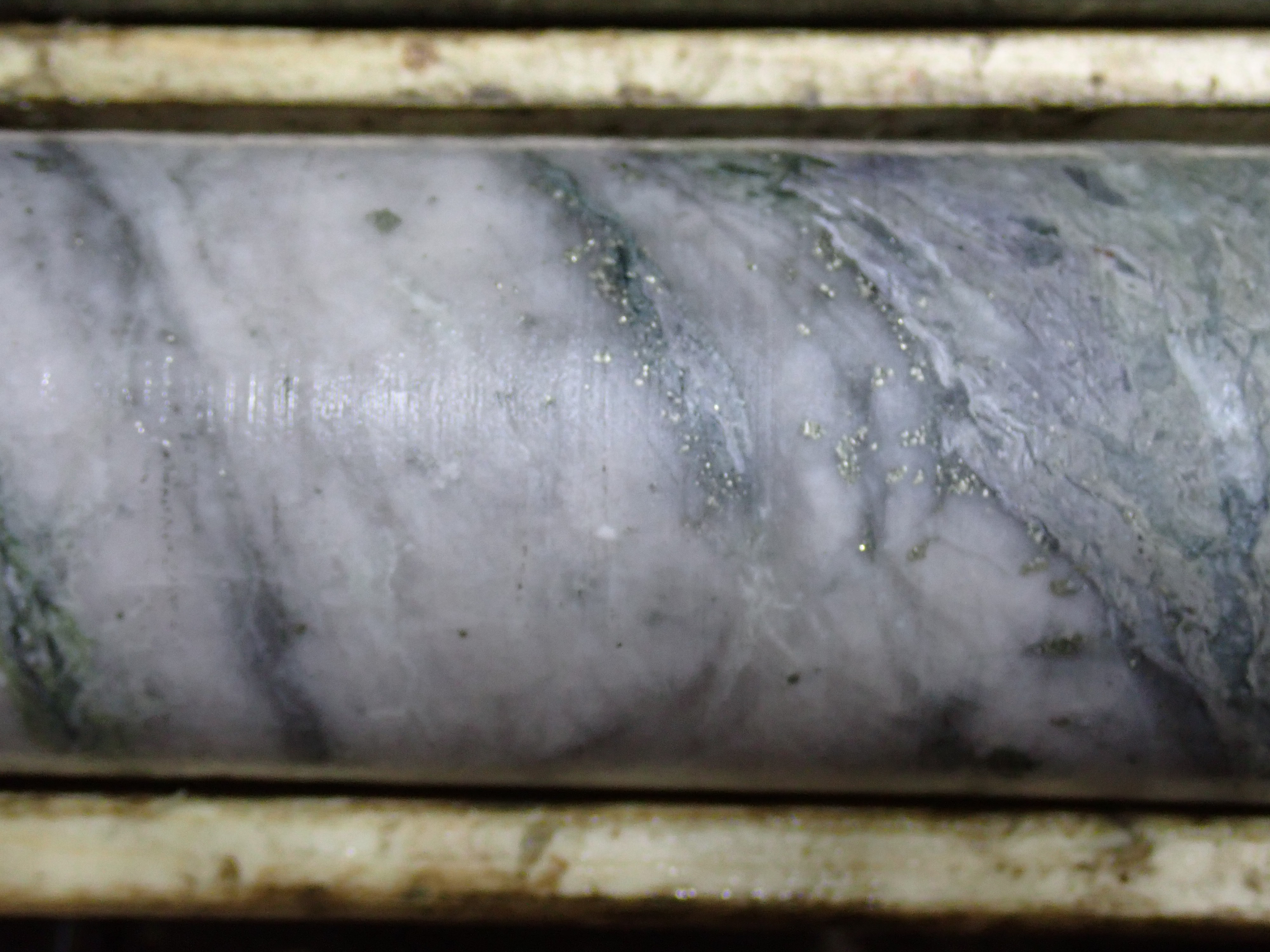
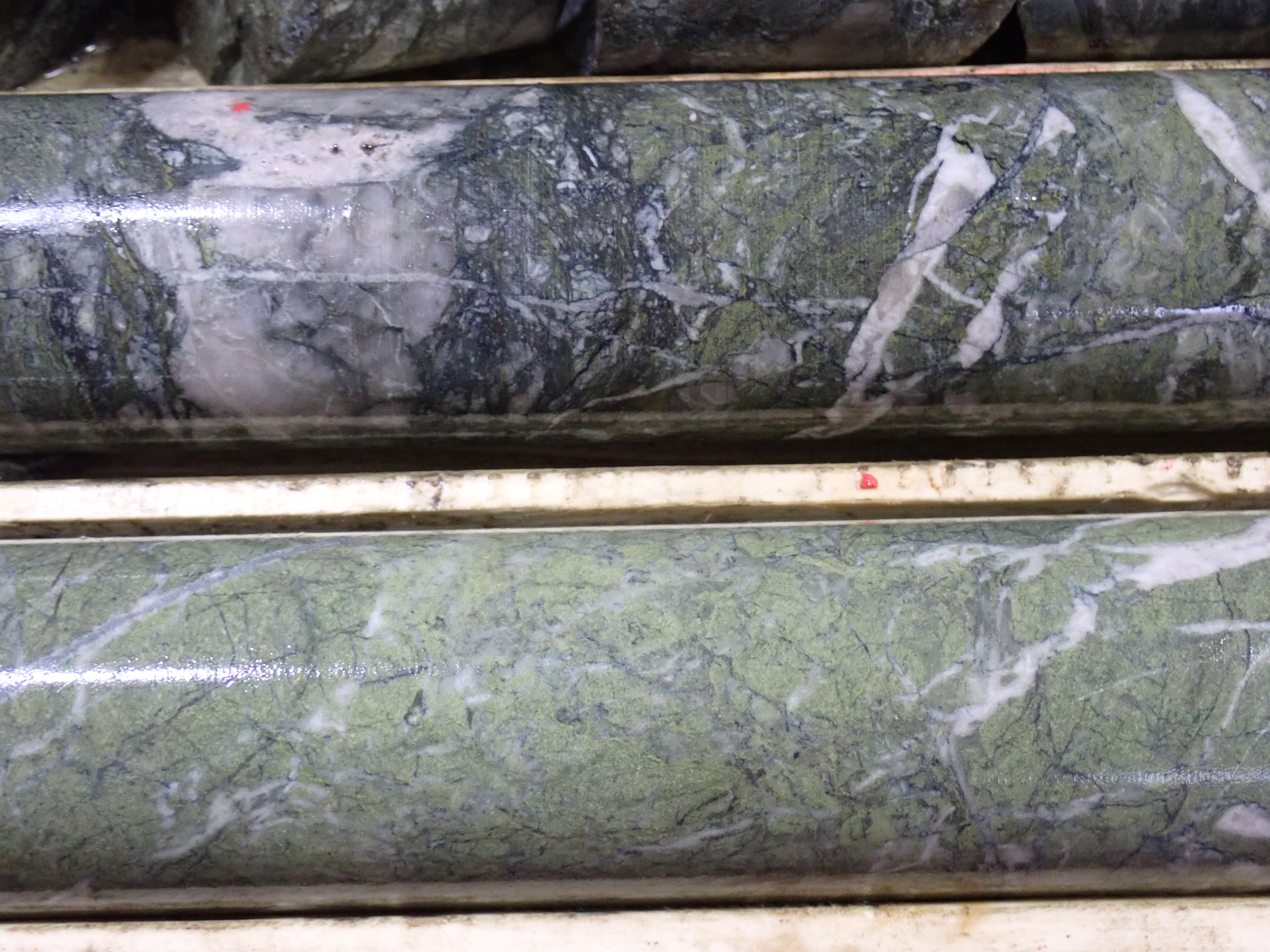
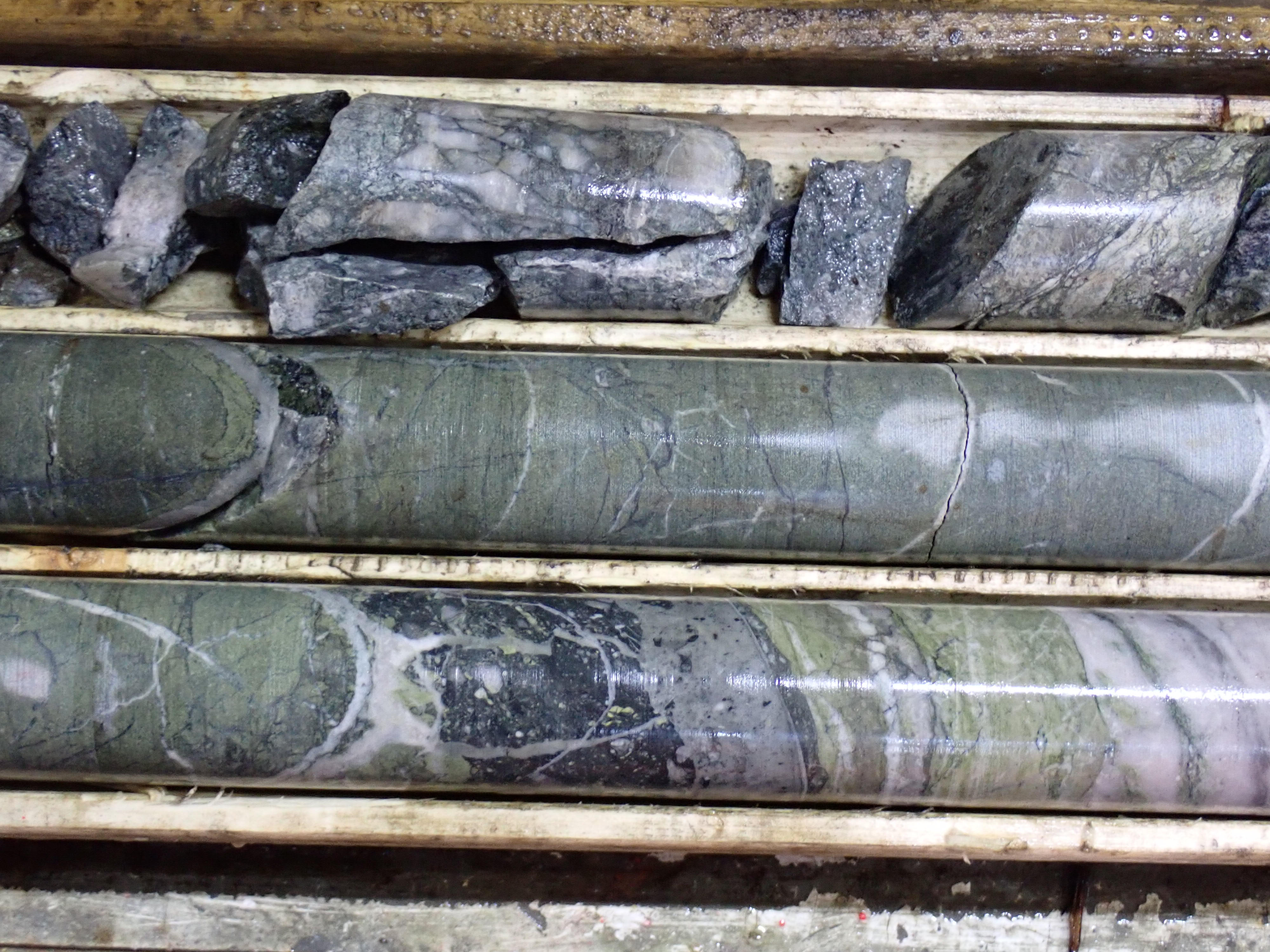
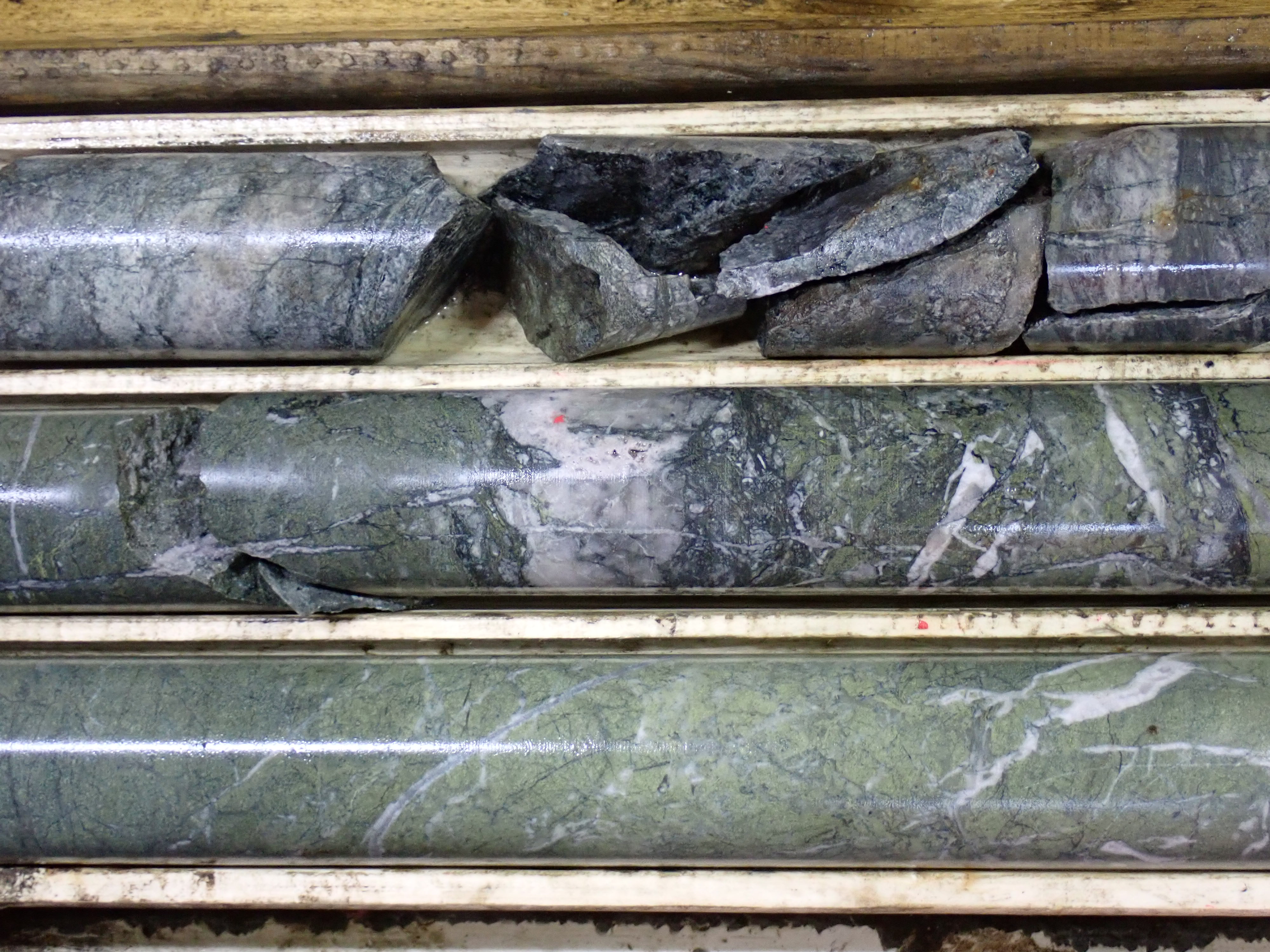
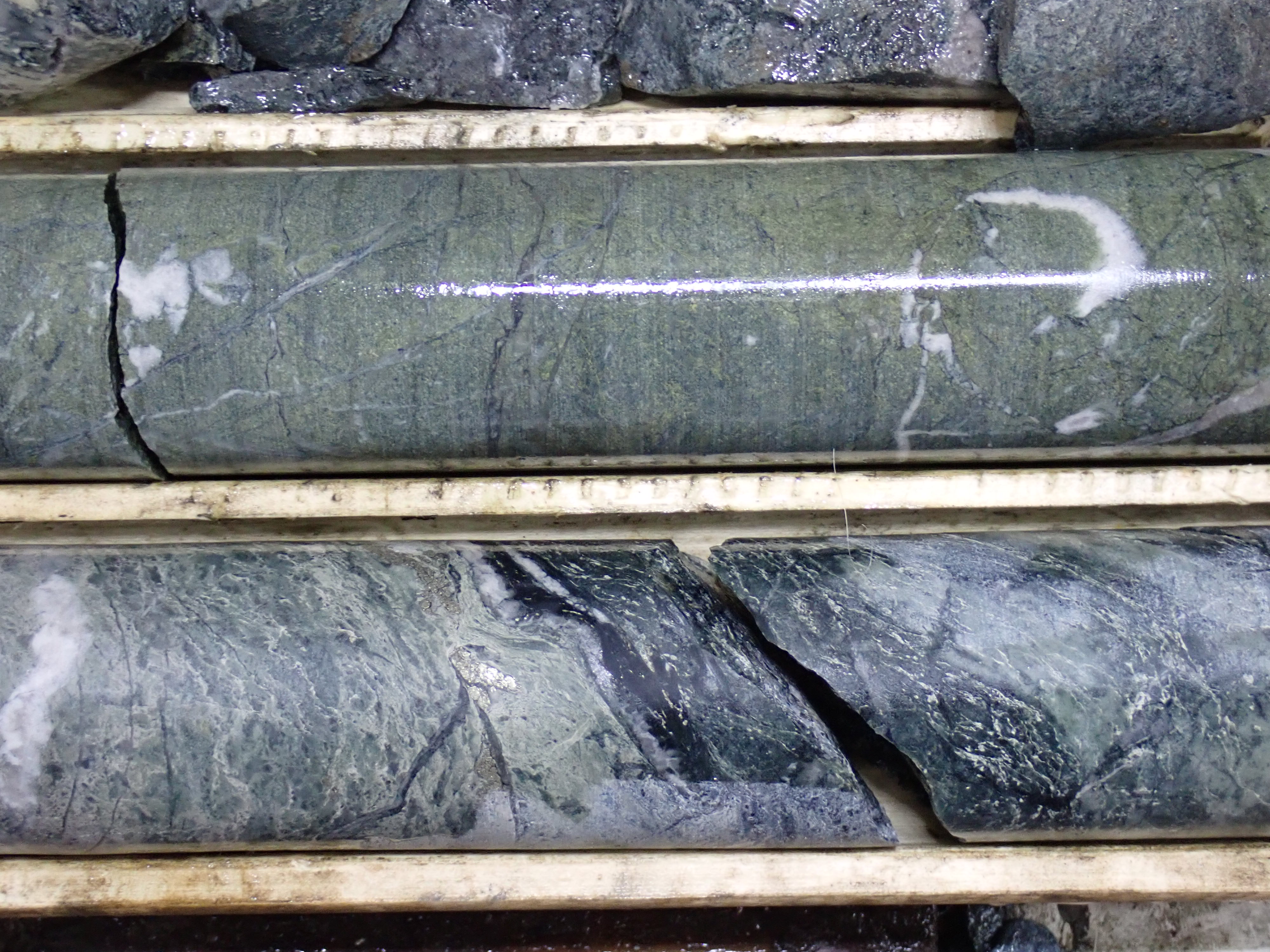
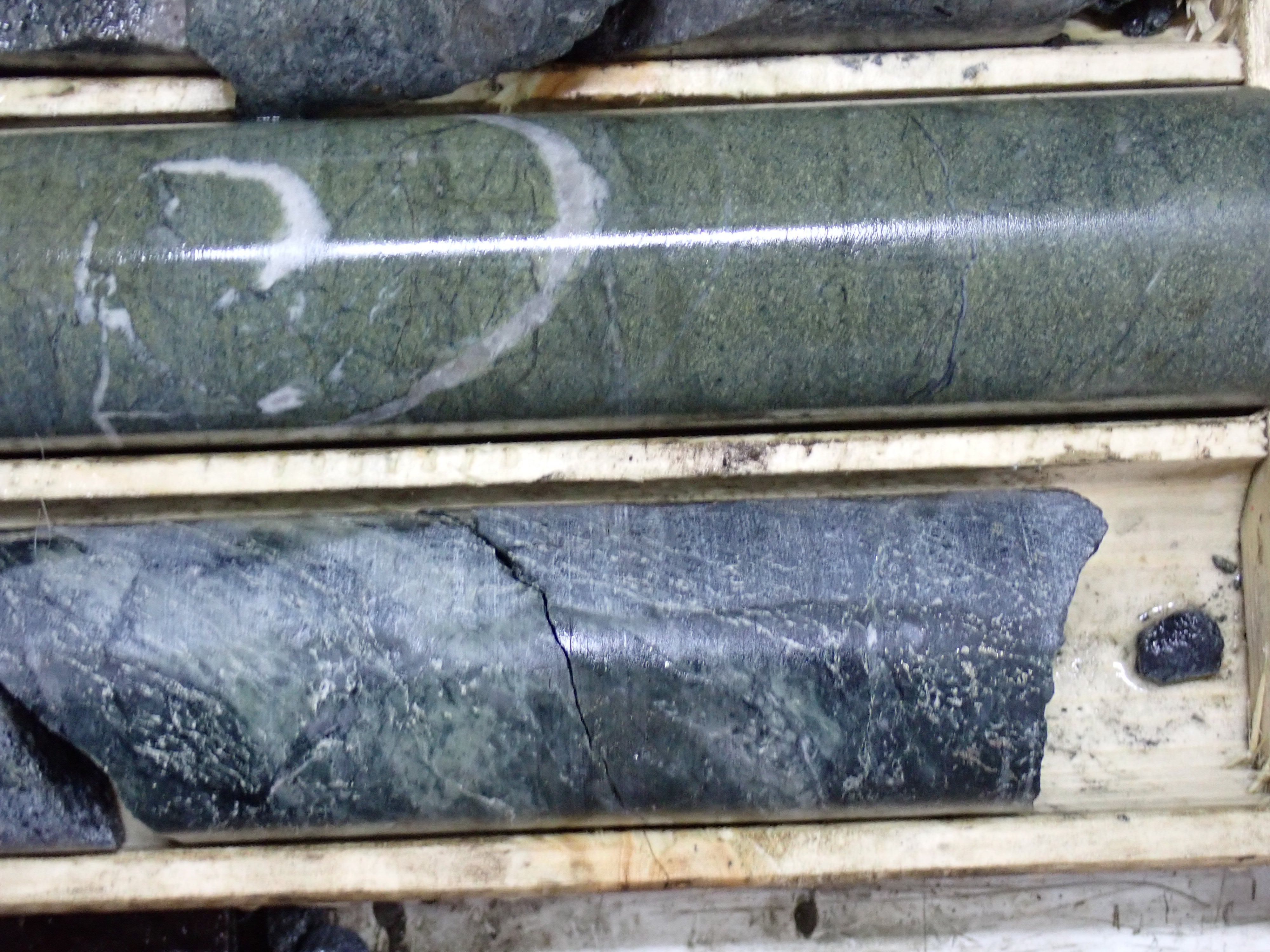
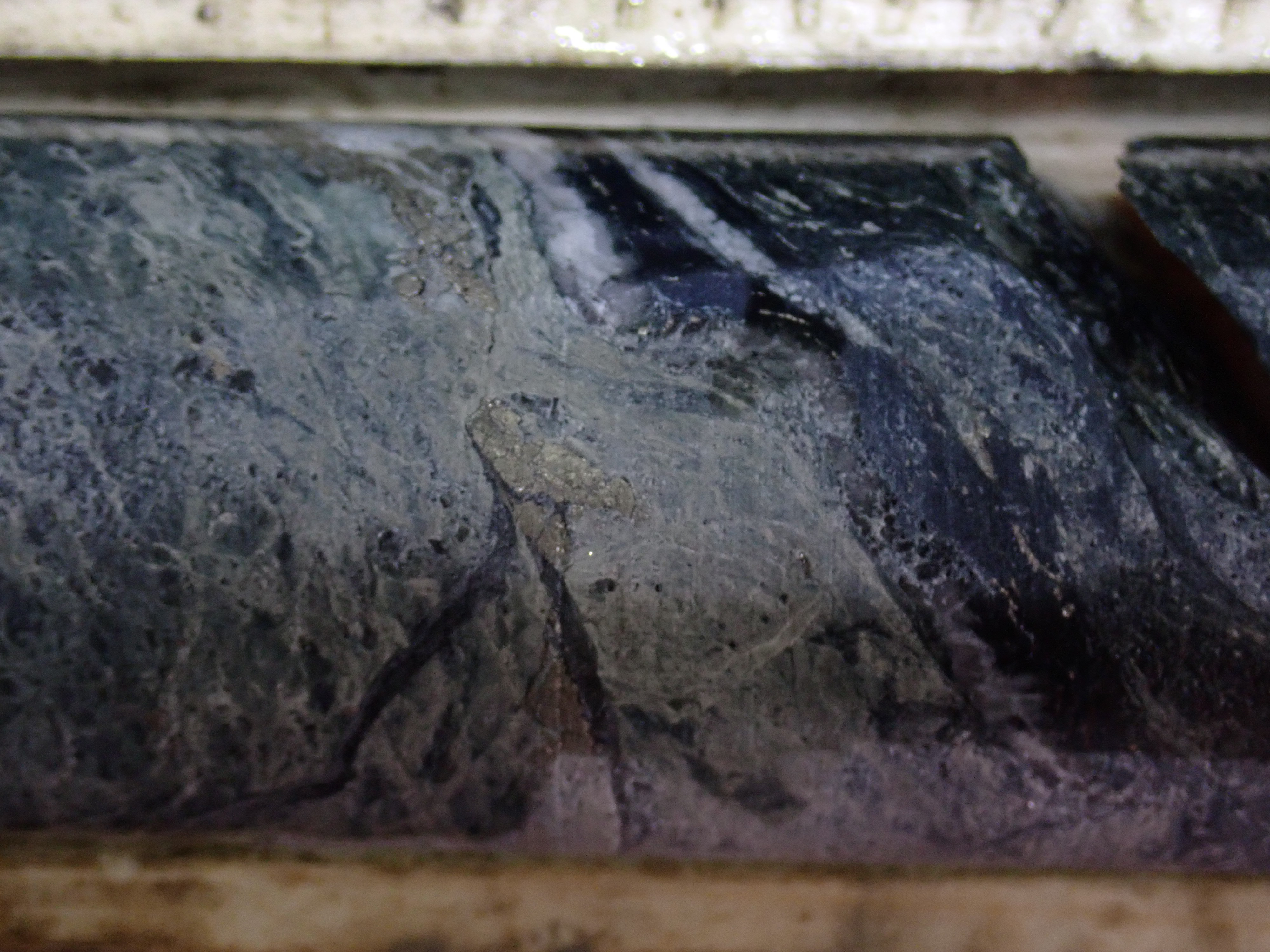
Zone by zone: their log, our re-log, the core
Top to bottom down the hole. Left: what CSCW logged and reported. Right: what the re-log found and measured. Then the core itself – click a box photo to see it full size.
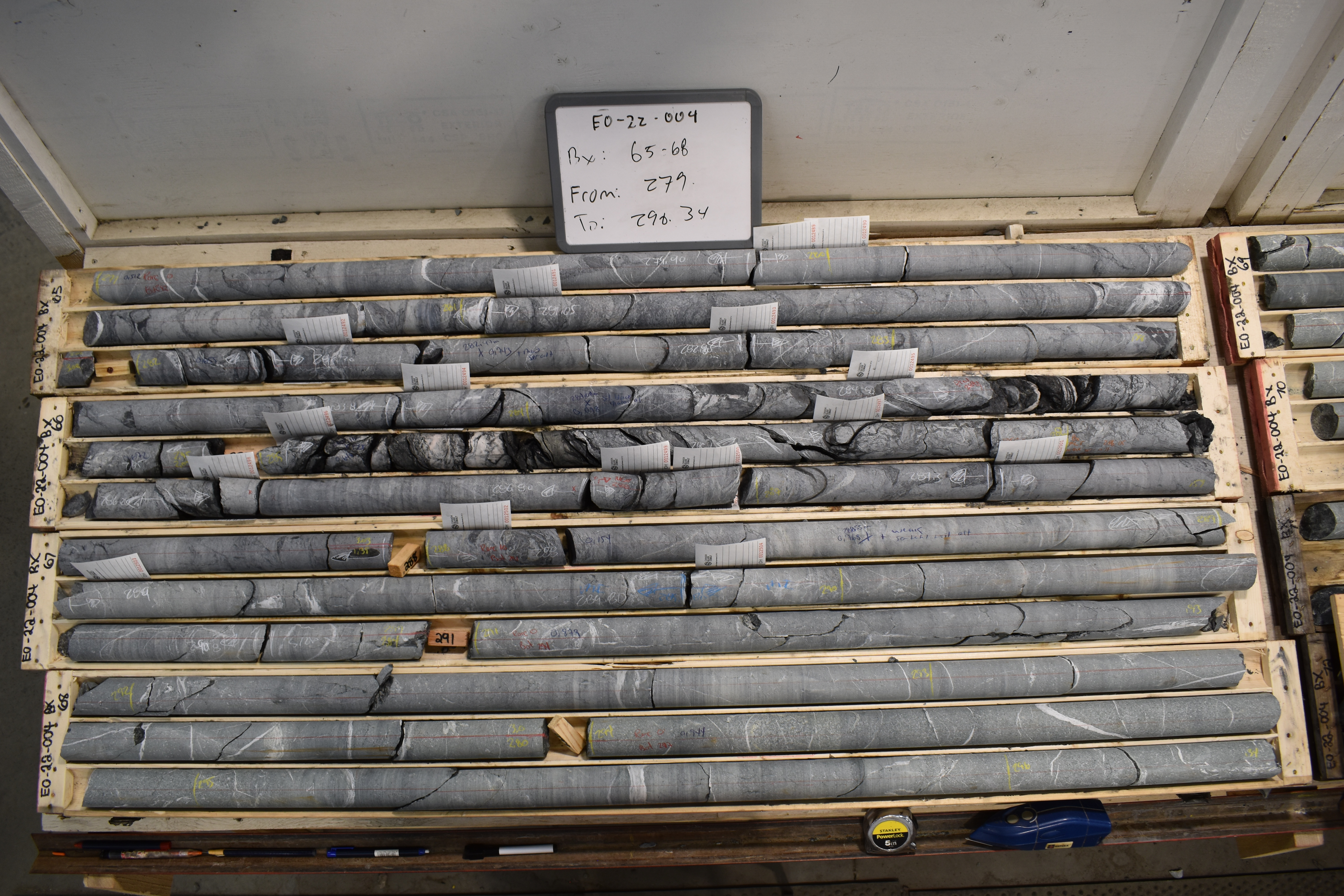
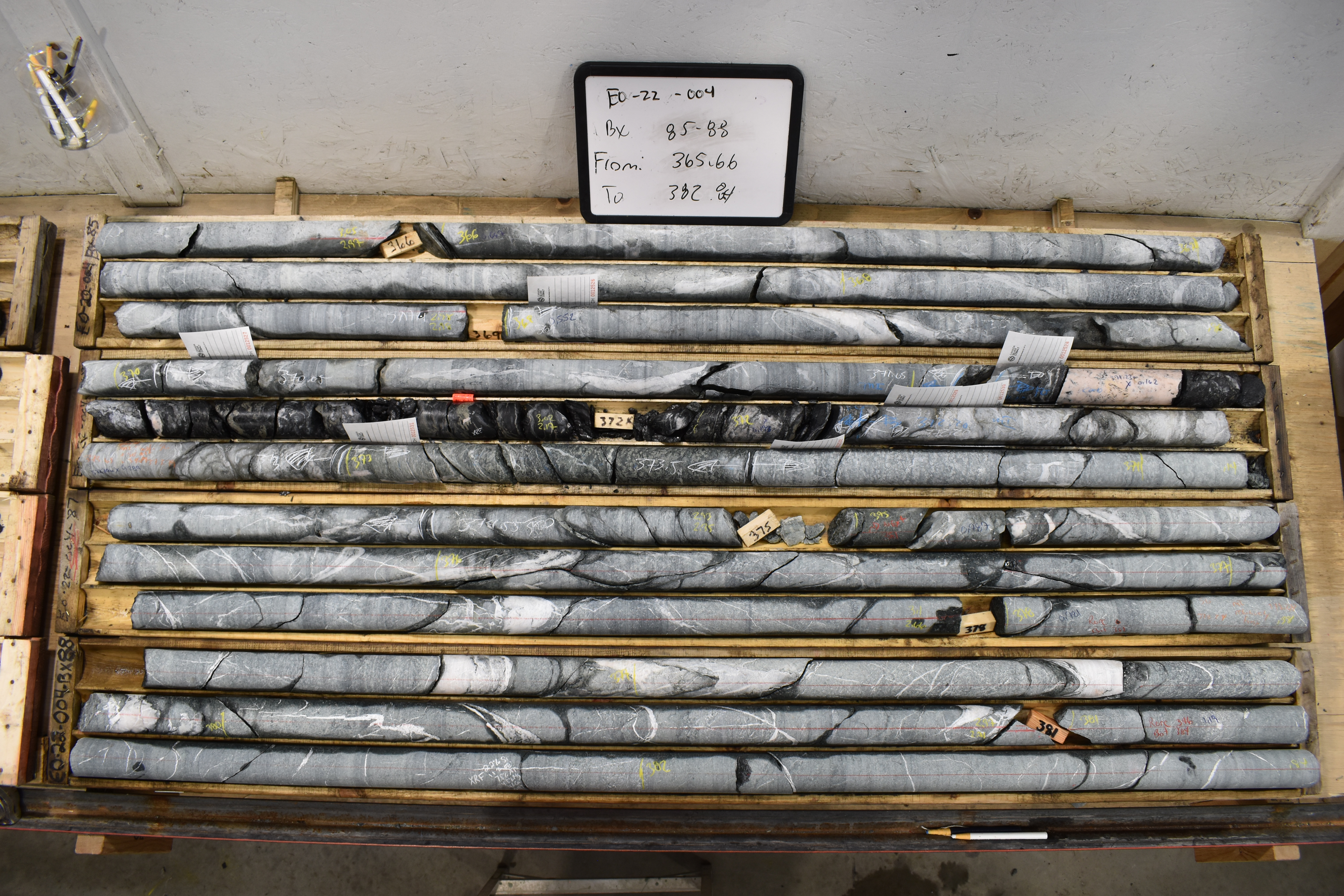
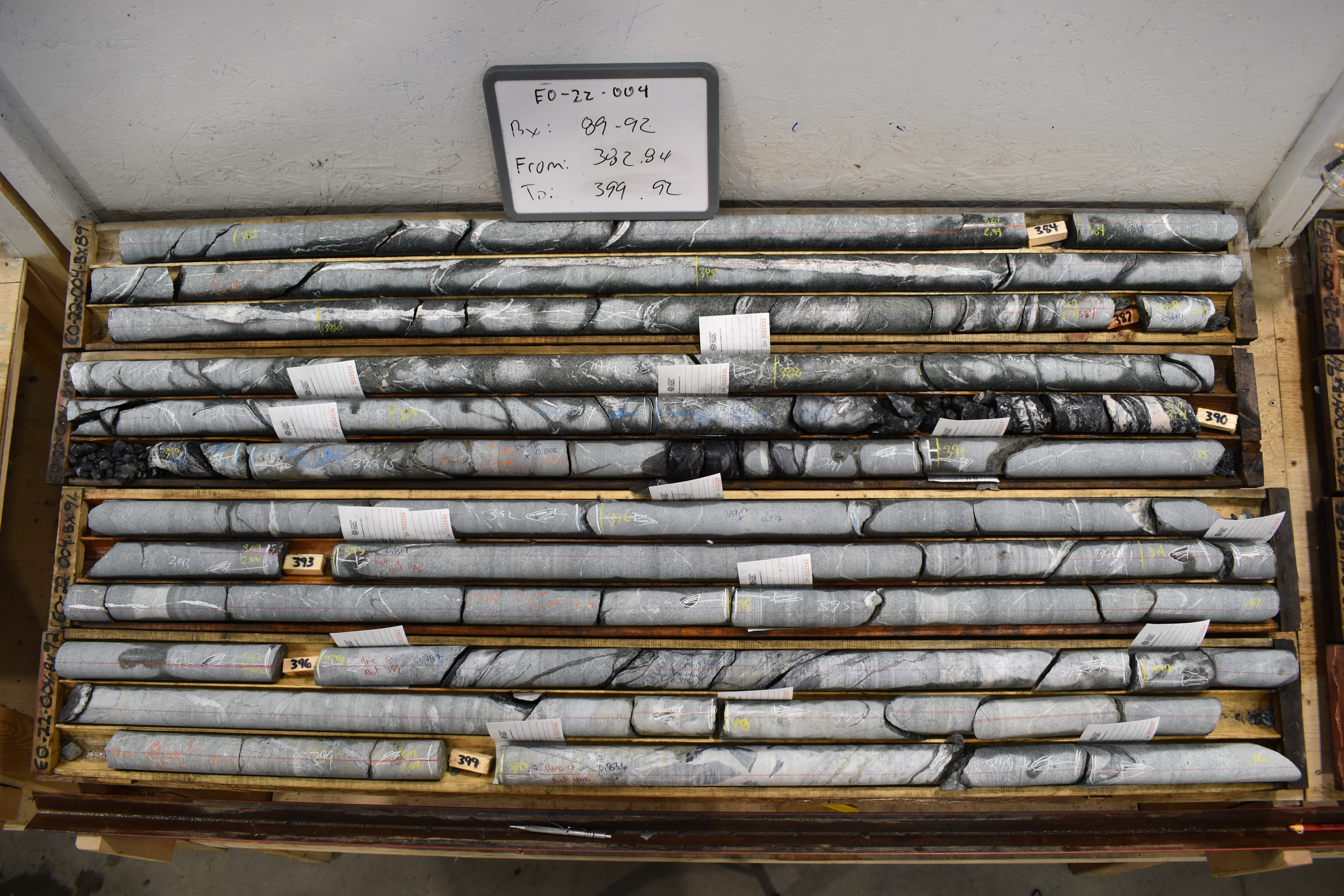
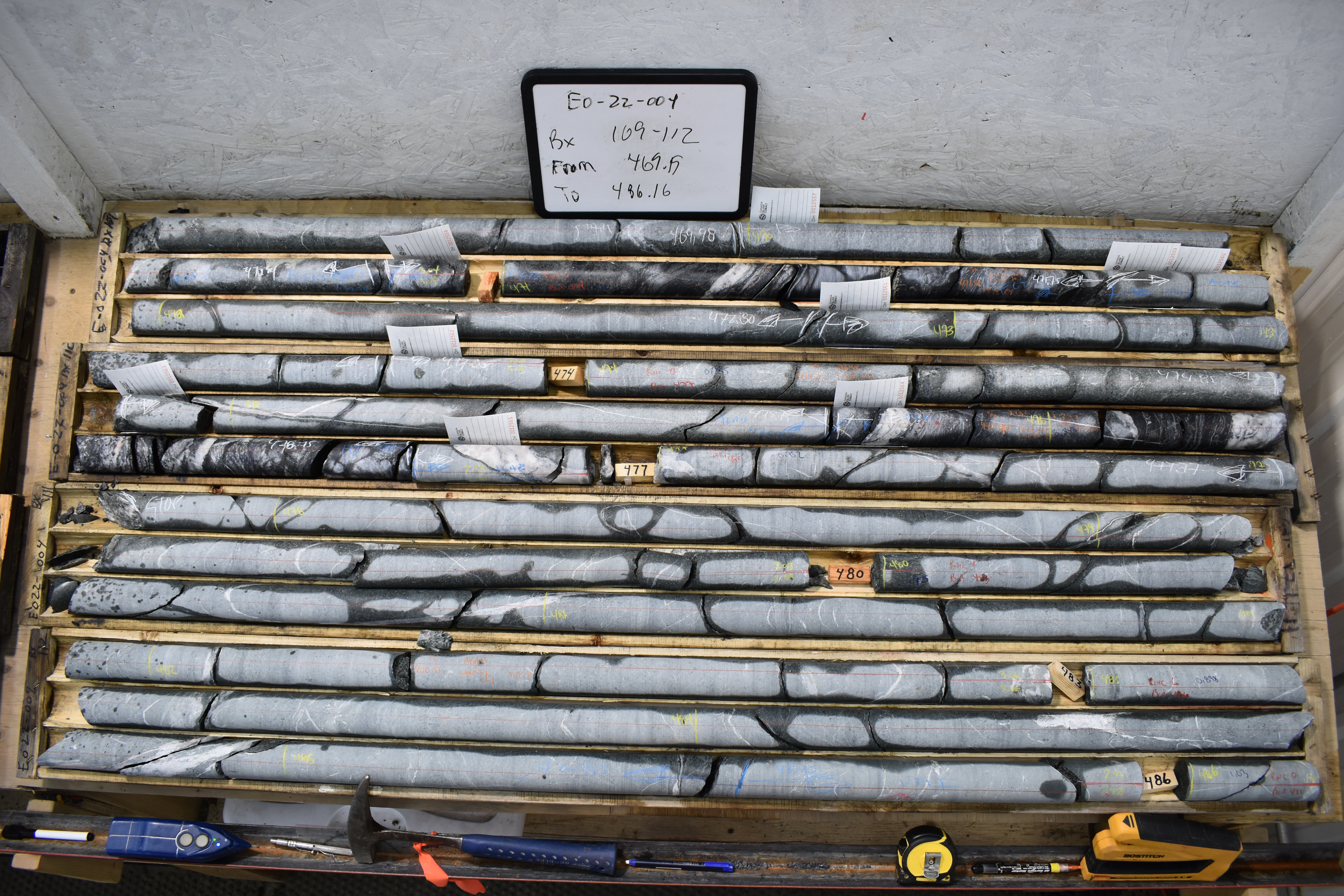
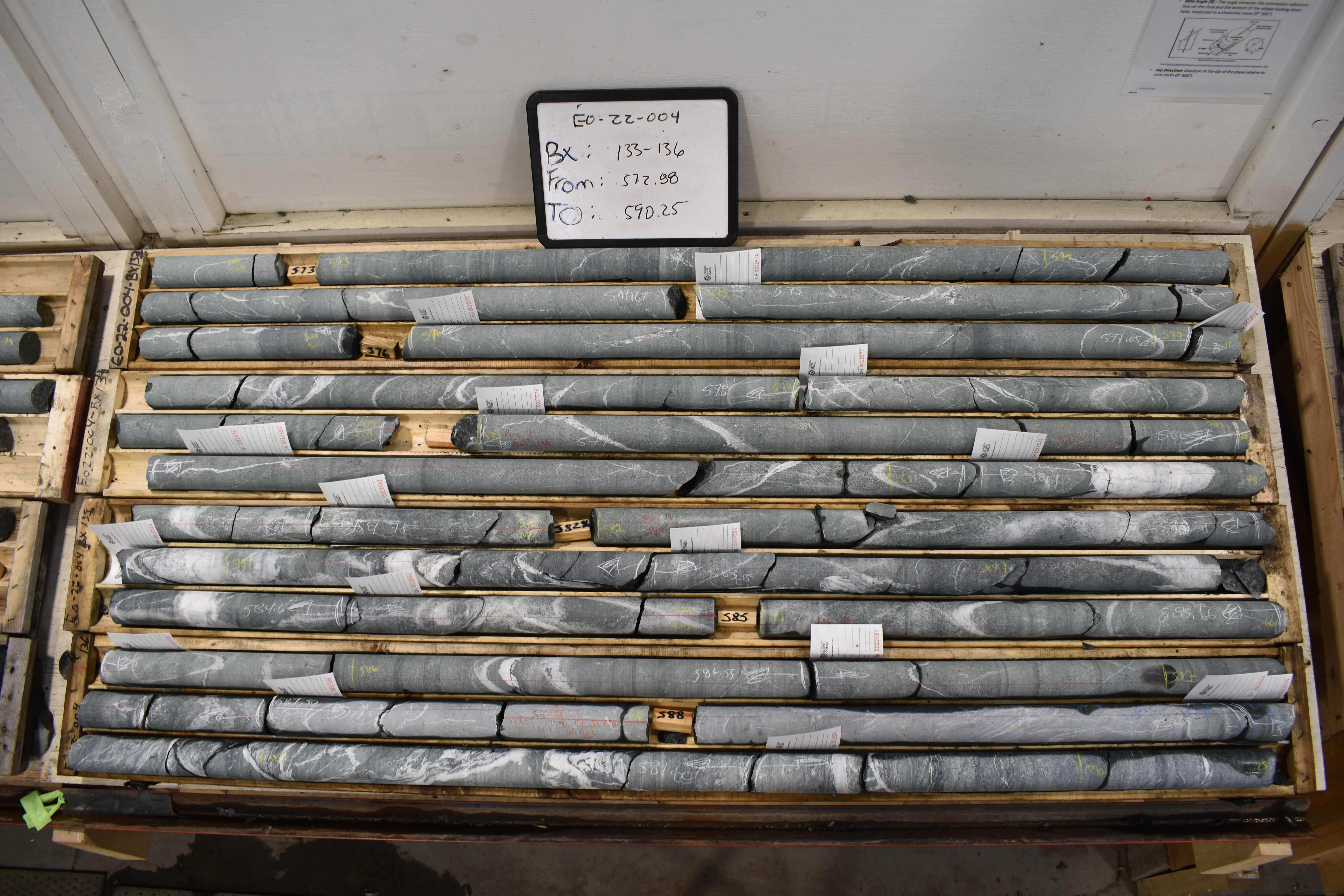
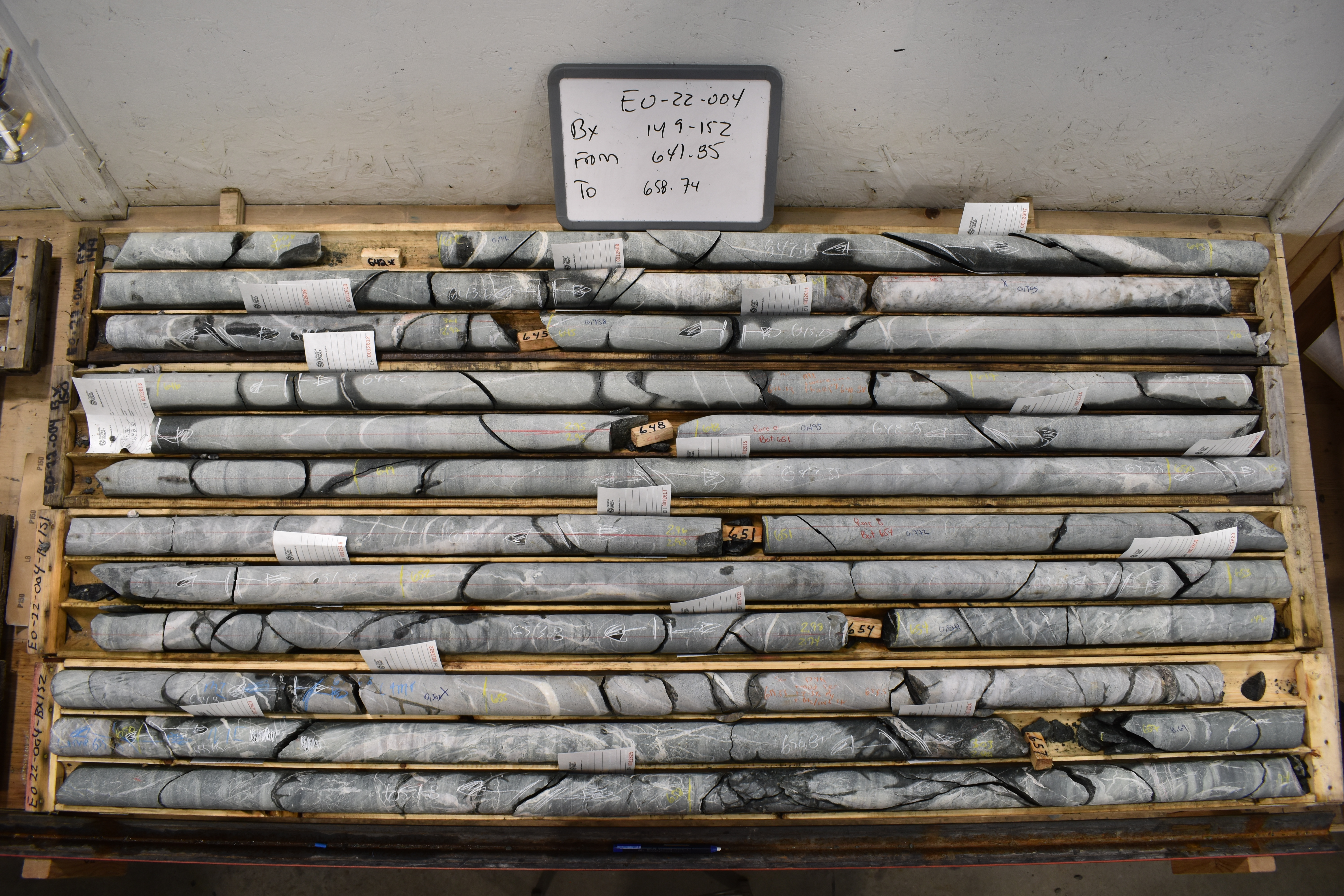
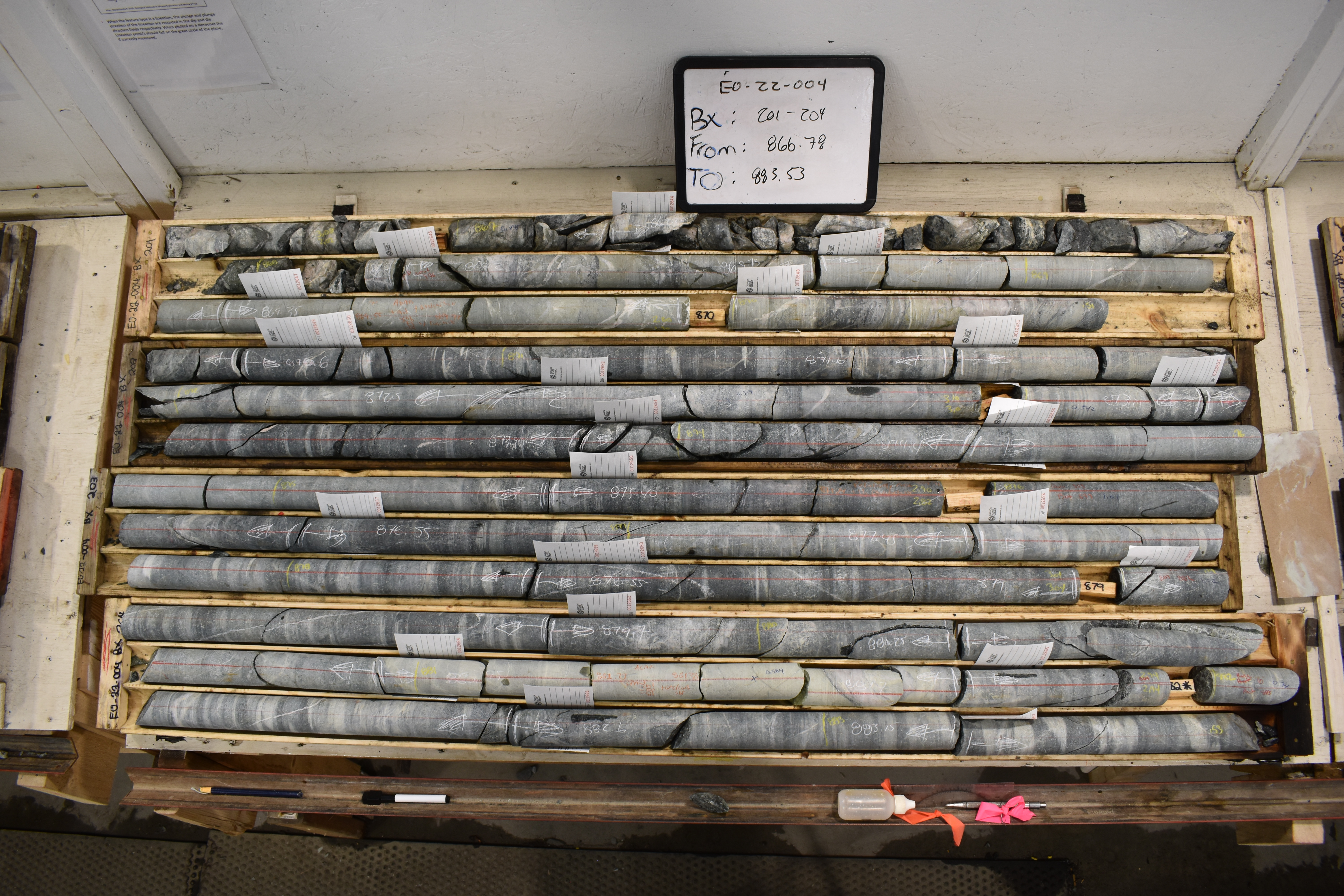
Depths are along the hole. CSCW wording from their log as quoted in 20000021754, pp. 57–60 (log in 20000020818 part 1); Zone 1 report quote from 20000020818 part 2. Re-log: Doug Robinson’s certified log, 2025. Grades calculated by Doug Robinson from the company’s assays (certificate A22-19030). On surface about 200 m east of Zone 1, a 25-inch quartz vein (the R vein) assayed 1.358 g Au/mT (p. 207).
Why the original rock-property numbers can’t be leaned on
Specific gravity is the best check that a rock type and its alteration were logged correctly – but only when the logger reconciles each reading with the lithology and alteration logs while logging.
Specific gravity
In CSCW’s log the two main units, “mafic intrusive” and “Archean gabbro”, came out with virtually identical SG ranges and averages: the log didn’t separate them. The readings were accurate, but lacked the quality assurance – a check that each piece measured is the rock logged – needed to be useful (20000021754, p. 227).
Magnetic susceptibility
Taken at fixed 3 m core markers with no logger comment on each reading. Readings like these can be compared with the magnetic survey at that point in the hole, but they can’t explain a magnetic anomaly or a rock type away from the hole (pp. 228–229).
What this means
- One hole was drilled, at the far west end, for the deep break. It crossed five fault and alteration zones with matching geochemical anomalies, and its deepest zone – in strongly altered gabbro – carried the best gold (0.32 g Au/mT over 1.55 m). Those are leads.
- The hole tested no conductor (p. 230). The black zones blamed for the conductors measured 0.0 S/m.
- CSCW’s own IP report recommends more drilling (p. 33). Three of the four planned holes, the IP targets and the Reed showing (14.04 g Au/mT over 0.40 m) were never drill-tested – see every hole in the Property Viewer.
- A program stopped after one hole tells you about the program, not about the property.
Drilling and targets The Reed showing About Doug Robinson, P.Eng. Investor access
Every source
- CSCW, 2023 – Report on Drill Core Assay and Geochemical Results at the Reed-Robinson Claim Group (M. Hewton, J. Chen-Tran): 20000020818 part 2 (PDF).
- CSCW, 2022 – Report on a Diamond Drilling Program at the Reed-Robinson Claim Group: 20000020818 part 1 (PDF) · record.
- CSCW, 2022 – Ground Geophysical Survey Work Report on a 3D DCIP Survey at the Reed-Robinson Claims (G. Kiessling, VP Exploration): 20000020817 (PDF) · record.
- CSCW / EarthEx, 2022 – UAV-borne magnetic survey and 3D inversion, Eby Otto project (D. Card): 20000020517 (PDF) · record.
- Doug Robinson, P.Eng., 2023 – Report on Deposit-Alteration Modeling, 2021 Fieldwork, Reed Robinson Property: 20000021754 (PDF) · record.
- Doug Robinson, P.Eng. – certified re-log of EO-22-004 (completed 27 June 2024, certified 15 October 2025) and box log of SG and magnetic susceptibility (July 2024). Unpublished; investors can ask for it.
Quotes from filed reports are short extracts from public filings. A grab sample is selected by hand and is not necessarily representative. Results from surface samples and other holes do not show what the property contains at depth.